Bentonite Cat Litter Benefits and Limitations: Our Perspective at LINGSHUAI
We explain the benefits of our bentonite base and how we address dust, tracking, clump handling, weight and disposal in our product specifications.
By LINGSHUAI
Bentonite gives us a practical mineral base for our clumping mineral cat litter: it takes up liquid, helps wetted particles bind together and can be processed into different granule formats. Those benefits are why it remains the main material in our LINGSHUAI cat litter range.
It also comes with limits. Dust release, tracking, weight and disposal all need consideration. Even a firm clump does not answer every performance question: it may hold together well yet adhere to a tray surface.
Our manufacturing work is about developing a defined product around these characteristics. We connect raw material preparation, granulation, drying, screening and formula choices with the finished specification, rather than describe every bentonite litter as having the same strengths and weaknesses.
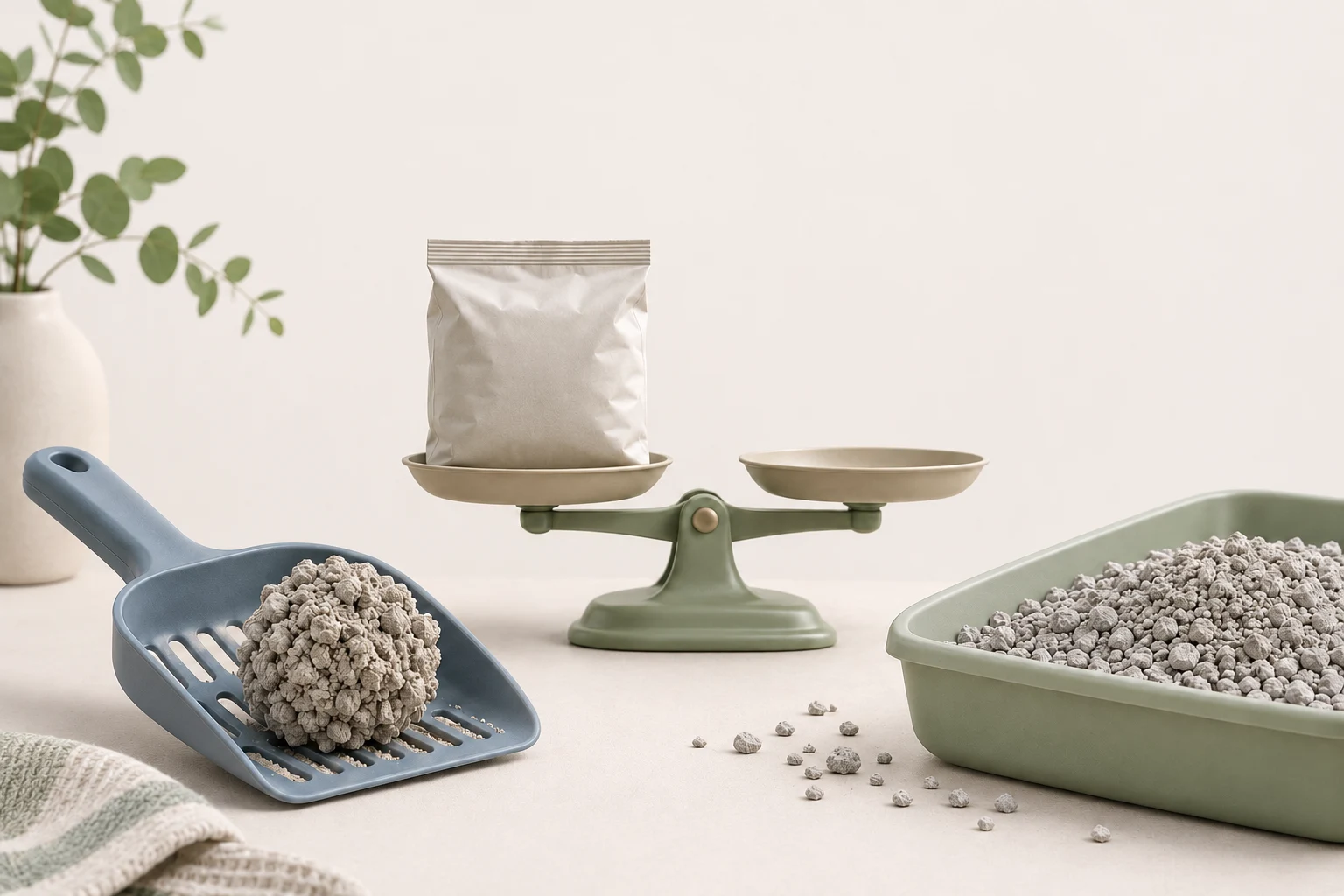
An original conceptual illustration, not a photograph of a LINGSHUAI product or a performance test.
1. Why Bentonite Remains the Main Material in Our Cat Litter Range
Liquid Absorption and Clumping Support Selective Waste Removal
In our clumping formulas, the clay’s interaction with liquid helps form a localised mass that can be separated from surrounding loose litter. This is the practical value of clumping: the wetted portion can be removed selectively, rather than treating the entire litter bed as one uniformly soiled mass.
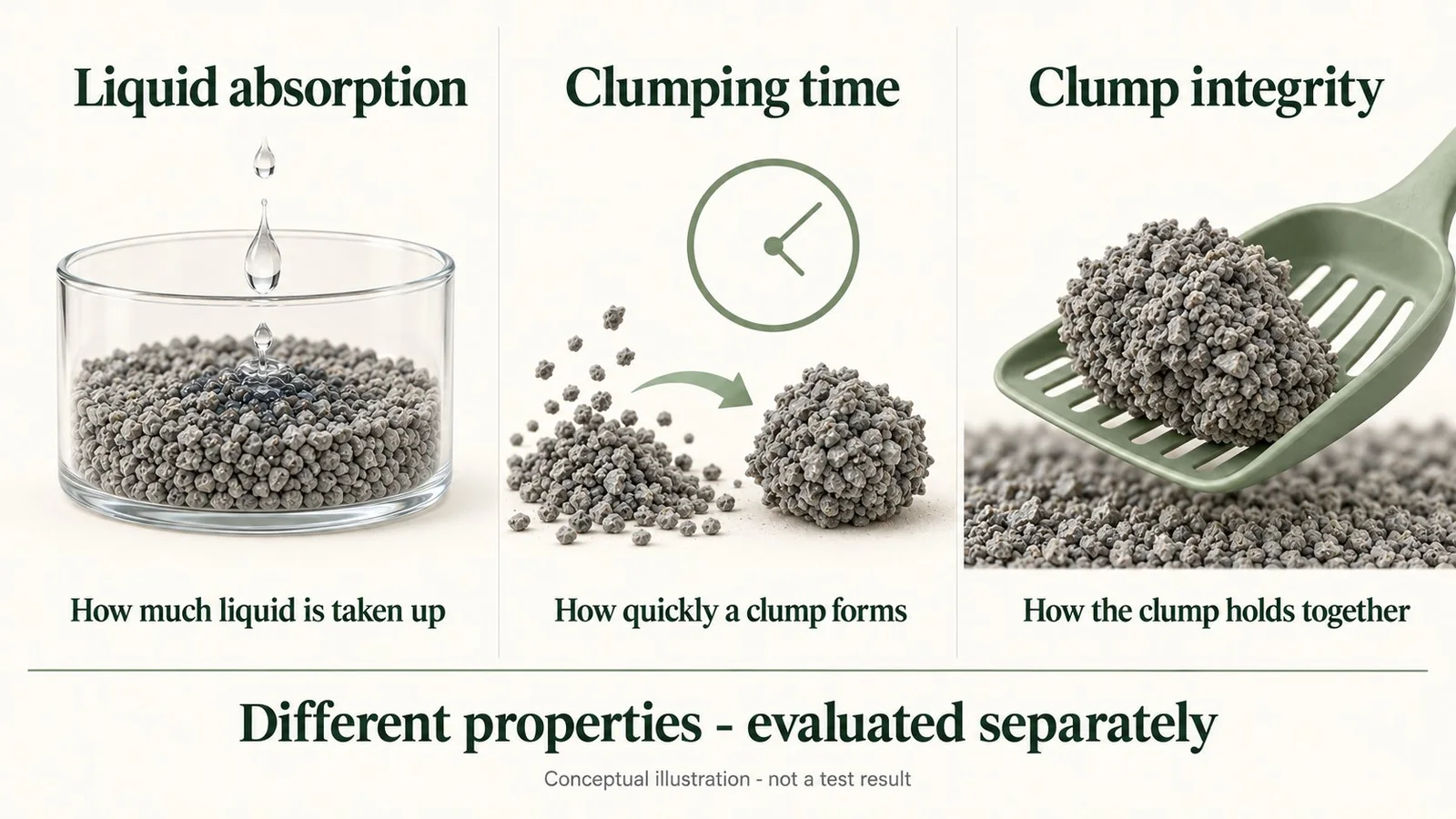
That does not establish a fixed bag life or a guaranteed reduction in consumption. The amount of material involved in a clump, its integrity during removal and the actual use conditions all affect the outcome. We evaluate absorption and clumping as related but separate properties.
Our article on why bentonite absorbs water and clumps explains the material mechanism in more detail.
A Mineral Base We Can Develop into Different Granules and Formulas
We manufacture round, fine-granule and crushed bentonite formats. These give us different ways to prepare the mineral base for a product specification. Particle size and shape influence how granules pack, contact one another and behave during pouring and scooping.
We do not treat one shape as universally superior. The useful question in our product discussions is how a particular granule format works with the formula and the intended requirements. A change in particle size may affect several properties together, rather than improve every aspect at once.
How We Build Odour-Control Options Around the Bentonite Base
Absorbing liquid and forming removable clumps help separate wetted material from the remaining litter. We can also develop formulas using ingredients such as activated carbon or zeolite for odour-control requirements.
These functions need clear descriptions. Fragrance provides a scent; it is not, by itself, evidence of odour removal. Similarly, the presence of an odour-control ingredient does not establish a removal percentage for the finished product. Any numerical claim needs the corresponding product and test conditions.
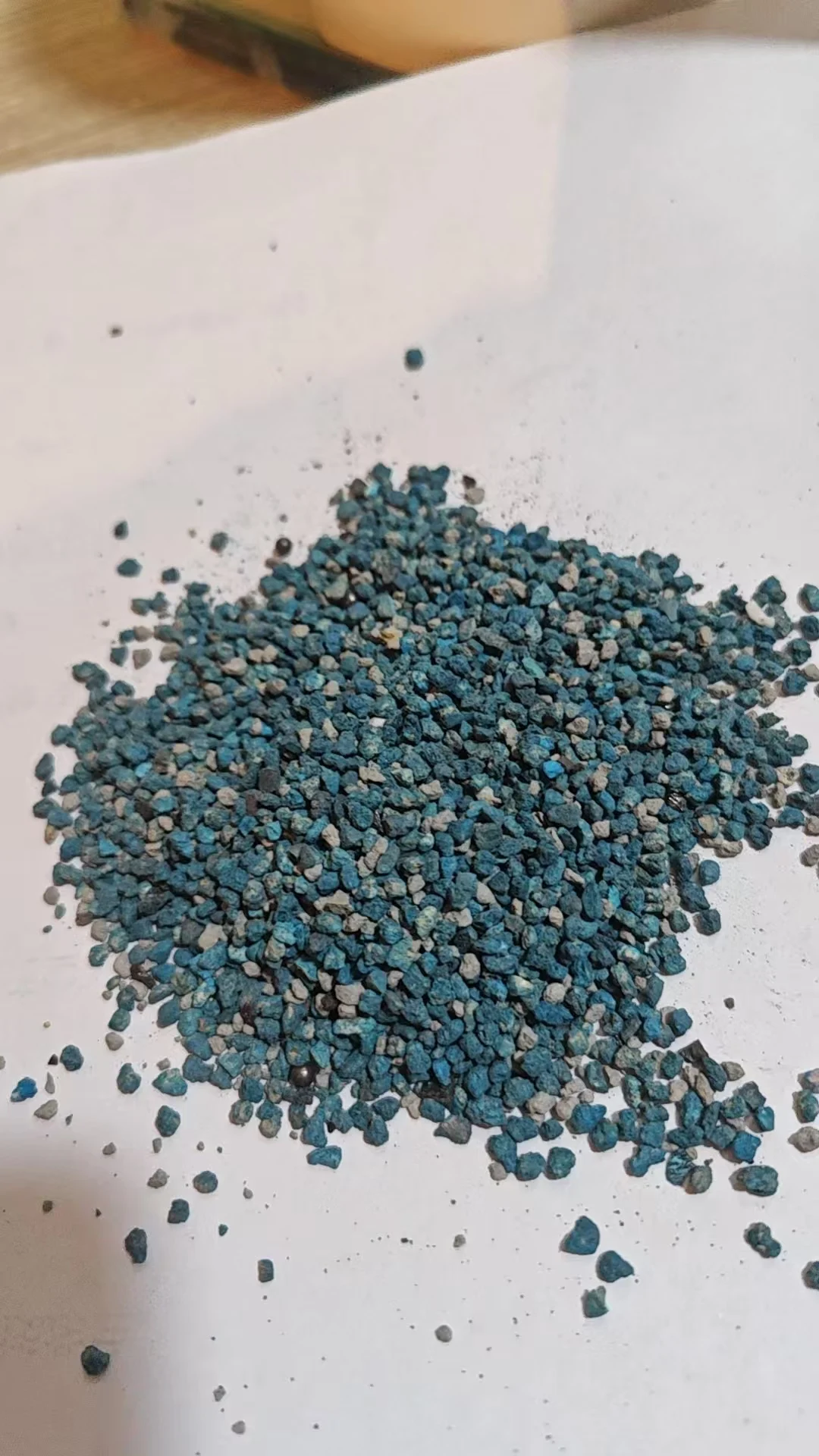
Zeolite material photographed in our supplied materials library. The image shows its appearance; it does not demonstrate an odour-removal rate.
2. Dust and Tracking: Two Limitations We Address Differently
How We Manage Loose Fines and Dust Release
Bentonite is a mineral material that can contain loose fine particles or generate them through abrasion. Some of those particles may become airborne when the litter is poured or disturbed. Granule condition, moisture, screening and subsequent handling can all affect the result.
Our documented production routes include dust collection at relevant stages, together with drying and screening. Screening helps separate material by the target particle-size range, while dust collection manages dust released during processing. Those operations contribute to production control; their existence alone is not proof that a finished bag releases no dust.
We also examine pouring dust as part of our pre-shipment process. When reporting a result, we need the evaluation method and sample scope, rather than relying solely on a general phrase such as “dust-free”.
Why Low Dust Does Not Automatically Mean Low Tracking
Tracking is the movement of litter out of the tray, including granules caught around paws or carried during digging and movement. It is different from fine material becoming airborne. A litter can show relatively little visible dust and still leave granules outside the tray.
We therefore discuss these concerns separately. Particle size and shape matter, but so do the tray arrangement and the way the litter is used. We do not infer a “no tracking” claim from a dust observation or promise that a granule format prevents every grain from being carried out.
These distinctions also reflect questions raised in Reddit discussions about bentonite dust. We use those experiences to identify relevant questions, not as controlled comparisons between materials or brands.
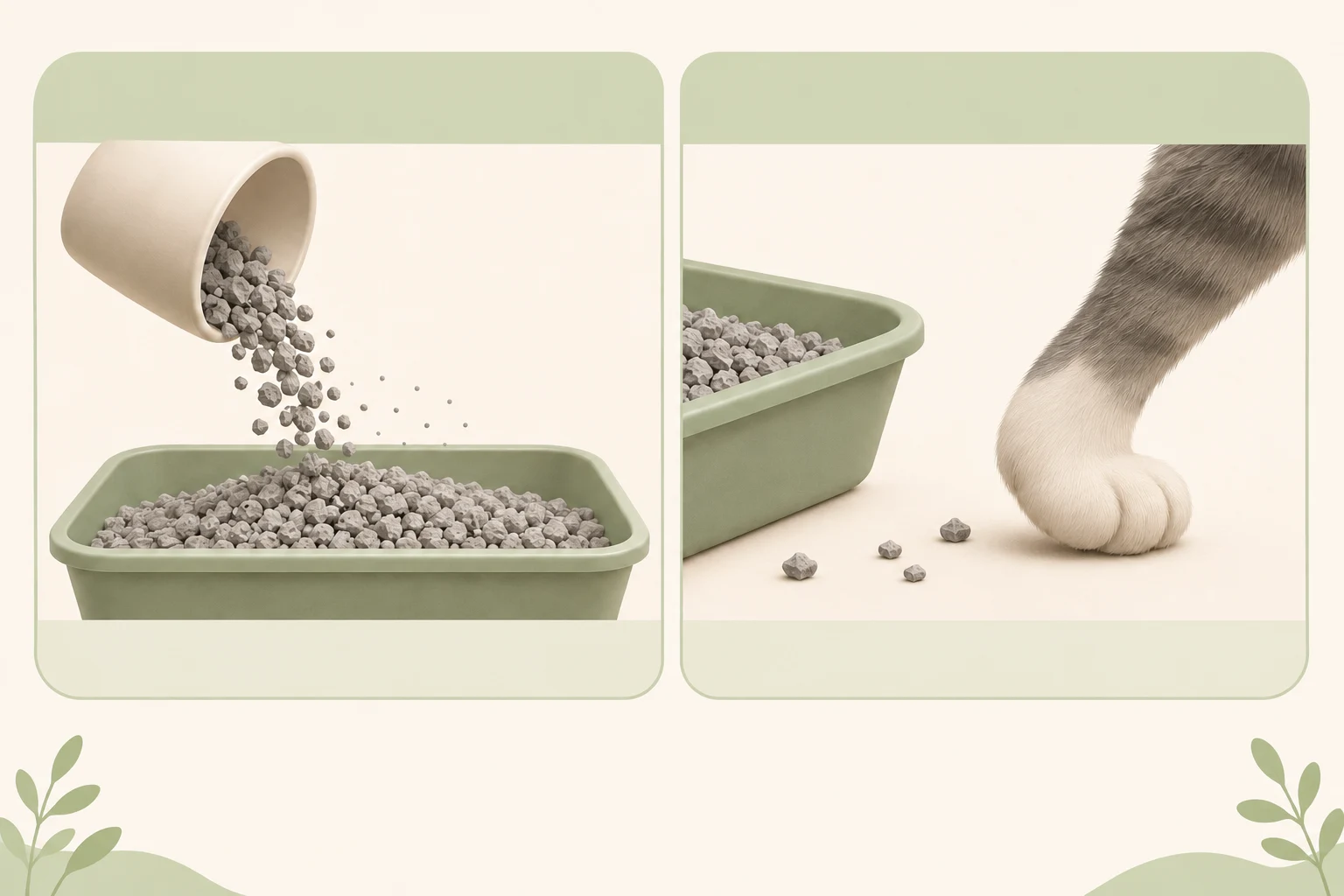
Dust release and tracking describe different events. This illustration is conceptual and contains no measured comparison.
3. Strong Clumping Has Practical Limits We Need to Consider
Why Clump Formation and Clump Integrity Are Different
A visible clump tells us that wetted material has gathered together. It does not fully describe how that mass will respond when lifted, shaken or disturbed. A short formation time is therefore not interchangeable with a measure of handling integrity.
In our evaluation discussions, we distinguish how quickly a clump forms from whether it remains together under the defined handling check. Liquid type, dose and waiting time also need to be clear when comparing samples. Otherwise, a difference in the evaluation may be mistaken for a difference in the product.
How We Assess Clumps That Stick to the Tray
Internal cohesion and adhesion to a tray surface are different observations. A clump may remain strongly bound internally but require effort to detach from the bottom. Describing it only as “hard” can overlook that practical limitation.
When examining such a result, we consider the liquid application, waiting time, litter depth and contact surface, alongside the sample’s condition. We do not assume every instance of sticking is caused by use conditions, or that making a clump harder automatically improves removal. The product and the evaluation conditions both deserve attention.
4. Weight and Disposal Are Part of the Material’s Limitations
Why We Discuss Pack Volume and Net Weight Separately
Bentonite is a mineral-based product, so handling weight deserves a clear place in packaging discussions. A pack labelled by volume still has a net mass, and the relationship depends on the product’s bulk characteristics and the filling arrangement.
We confirm the pack volume, declared net weight and packaging arrangement for the agreed product. This keeps the quantity description clear and makes handling weight part of the specification.
Why We Do Not Present Bentonite as Biodegradable or Flushable
Natural mineral origin does not make bentonite biodegradable. We therefore do not describe our bentonite base as a material that biologically breaks down like an organic fibre.
We also do not present bentonite litter as a toilet-disposal product. Public wastewater guidance, including Prince William Water’s flushing guidelines, identifies cat litter as material that should not be flushed. Disposal statements should reflect the product and applicable local requirements.
The material’s useful clumping behaviour does not remove these limitations. Nor do we turn natural sourcing or a single processing feature into a blanket environmental claim.
5. How We Balance These Trade-Offs in Our Product Specifications
Moisture, Granule Size and Formula Need to Work Together
Increasing moisture within a suitable range can help fine particles adhere and reduce their tendency to lift into the air. Excess starting moisture, however, may reduce further liquid uptake per unit weight and affect clump formation or integrity. Adding moisture is not a substitute for controlling loose fines and granule condition.
Particle-size changes also have connected effects. A different size distribution can change particle contact, packing and the way granules move during handling. We do not assume the finest grade gives the best overall result or that larger granules eliminate tracking.
The same principle applies to formula development: an ingredient choice needs to fit the finished product. We discuss the required balance with the customer and evaluate the relevant sample, rather than assign one “best” moisture level, granule size or additive combination to every project.
How We Connect Sample Evaluation with Pre-Shipment Checks
Every batch follows our pre-shipment inspection process. The relevant checks help connect production with the confirmed product specification:
| Performance concern | What we examine | Important distinction |
|---|---|---|
| Dust during pouring | Pouring-dust behaviour and granule condition | Visible observations are not automatically an airborne-dust concentration |
| Clumps breaking during removal | Formation and integrity under defined conditions | Fast formation alone does not establish handling strength |
| Variation in granules | Appearance, particle-size distribution and loose fines | A mineral name alone does not define finished granule quality |
| Packaging and handling weight | Agreed fill weight, seals and bag condition | Bag volume and declared net weight are separate specifications |
Tracking and tray adhesion also need their own evaluation conditions. We do not claim that a routine fines check measures tracking, or that a clumping-time result demonstrates resistance to sticking.
Product-specific third-party reports provide measurements for the samples and methods identified in those reports. They complement our routine checks; they do not become a new independent report for every shipment.
6. Discuss the Performance Balance You Need with Our Team
We continue to use bentonite because its absorption, clumping behaviour and processing flexibility provide a useful foundation for our products. Our work also includes dealing openly with dust release, tracking, weight, disposal and the differences between forming a clump and removing it cleanly.
Tell our team which properties your project needs to prioritise, together with the granule format, fragrance and packaging requirements. If you have sample-evaluation conditions, sharing them allows us to discuss results on the same basis.
Contact LINGSHUAI to discuss specifications and samples. Our business team will follow up with suitable product or formulation options for your requirements.
Why Does Bentonite Absorb Water and Clump? Our Manufacturing Perspective
We explain how bentonite forms clumps, how moisture affects dust and further liq…
Read more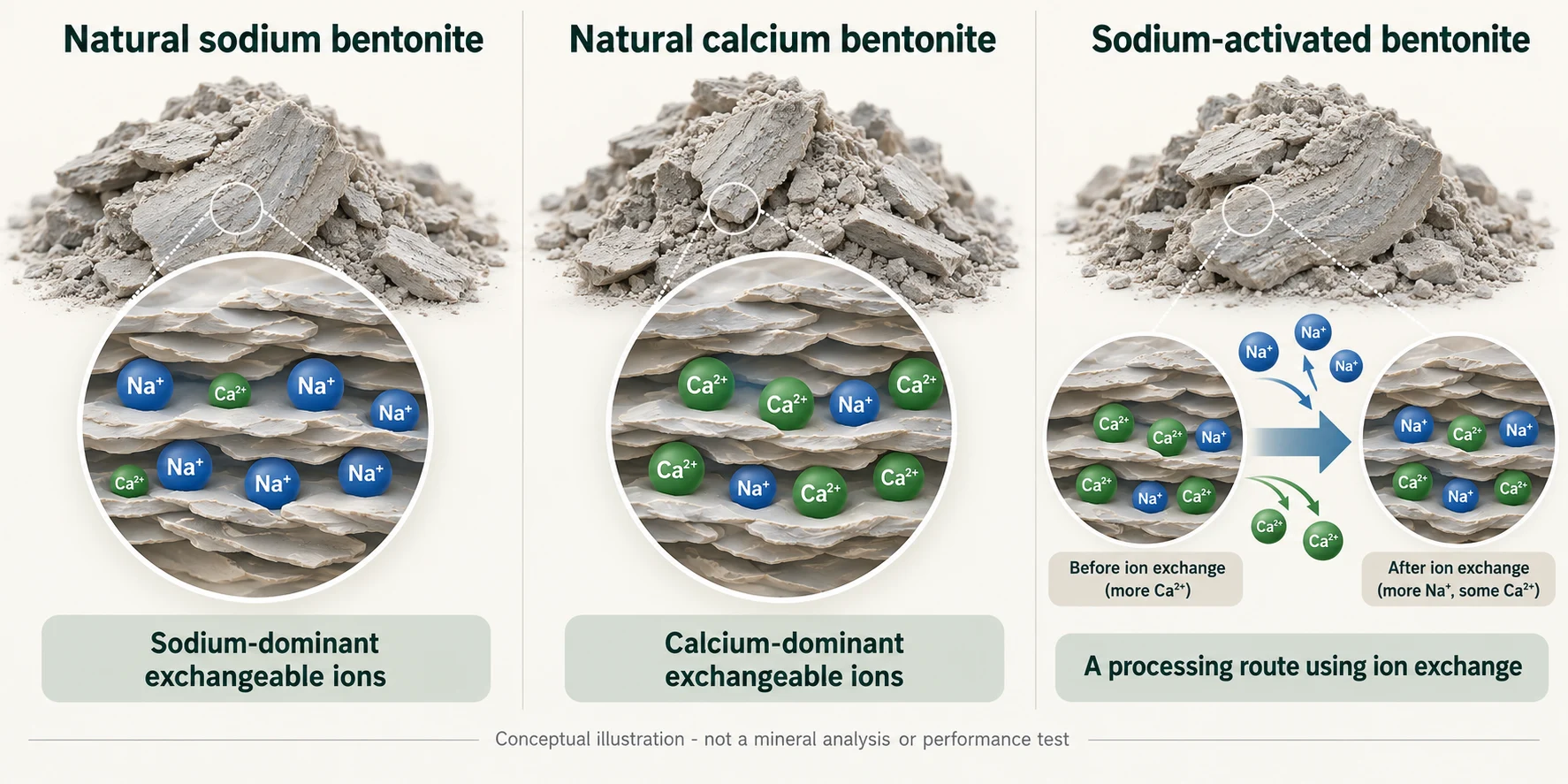
Sodium vs Calcium Bentonite: How We Explain the Difference at LINGSHUAI
We distinguish natural sodium, natural calcium and sodium-activated bentonite, t…
Read more