Sodium vs Calcium Bentonite: How We Explain the Difference at LINGSHUAI
We distinguish natural sodium, natural calcium and sodium-activated bentonite, then explain how our material preparation connects with finished cat litter performance.
By LINGSHUAI
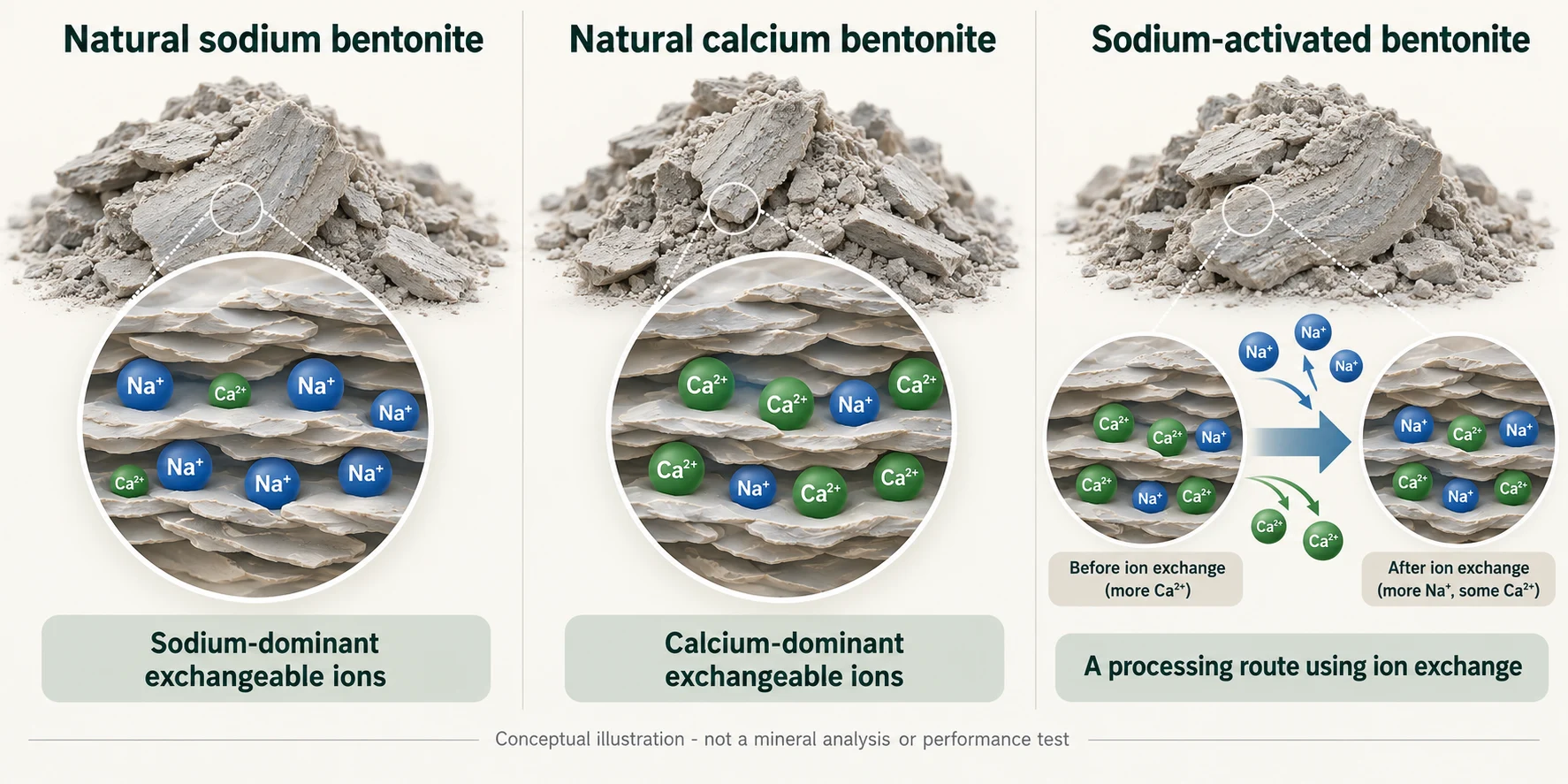
Sodium bentonite and calcium bentonite belong to the same family of clay materials. Their names describe the dominant exchangeable ions associated with the clay, which influence how it interacts with water. Sodium activation describes something different: a processing route that changes the exchangeable-ion balance of suitable raw material.
At LINGSHUAI, this distinction matters when we explain sodium bentonite clay cat litter and the processing behind it. Our documented process includes alkali treatment of calcium bentonite for sodium activation where required. We connect that preparation with granulation, drying, screening and finished-product checks, rather than describe a mineral name as a complete performance specification.
1. What Sodium and Calcium Mean in Our Bentonite Material Discussions
The Difference Starts with Exchangeable Ions
Bentonite contains smectite-group clay minerals, principally montmorillonite. These minerals have charged, layered structures associated with exchangeable ions. In sodium bentonite, sodium is the predominant exchangeable cation; in calcium bentonite, calcium predominates. Neither term necessarily means that only one type of ion is present.
This distinction concerns the clay’s exchangeable ions, rather than simply its total sodium or calcium content. A material name is therefore more specific than a list of elements, but it still does not describe every aspect of the ore.
Why the Mineral Name Does Not Describe the Entire Finished Product
Mineral composition and associated minerals can vary between deposits and materials. A finished litter also has a particular particle-size distribution, moisture content, granule structure and formula.
We distinguish three descriptions when discussing these materials:
| Material description | What the description means | What it does not establish by itself |
|---|---|---|
| Natural sodium bentonite | Naturally sodium-dominant exchangeable-ion character | A fixed absorption value, clump strength or dust level |
| Natural calcium bentonite | Naturally calcium-dominant exchangeable-ion character | That the material cannot absorb liquid or be further processed |
| Sodium-activated bentonite | Material treated to shift its exchangeable-ion balance towards sodium | That it is untreated natural sodium bentonite or identical to every natural sodium material |
The illustration distinguishes material character from a processing route. It is not a mineral analysis or a performance comparison of LINGSHUAI samples.
2. Why Sodium and Calcium Bentonite Behave Differently in Water
How Sodium and Calcium Influence Swelling
Water interacts with clay surfaces and exchangeable ions, including within the spaces between mineral layers. Sodium and calcium influence these interactions differently. Sodium-dominant bentonite generally has greater swelling potential in fresh water than calcium-dominant material.
The WHO/IPCS technical review of bentonite describes the relationship between clay structure, exchangeable ions and water. The distinction helps explain material behaviour; it does not provide a single swelling multiple that applies to every finished cat litter.
Liquid composition also matters. Dissolved salts and the ions present in a liquid can affect swelling. Observations made with fresh water should not automatically be treated as equivalent to results with saline solutions or other liquids.
Why Greater Swelling Does Not Automatically Mean Stronger Clumps
Swelling describes a response to water. A usable litter clump also requires wetted granules to connect and remain together during handling. Greater swelling alone does not establish how quickly the finished product forms a clump or how well that clump withstands lifting.
For our manufacturing work, this is a reason to evaluate the finished formula. We explain the distinction between uptake, formation speed and integrity in our article on why bentonite absorbs water and clumps.
3. Where Sodium Activation Fits into Our Production
How Calcium Bentonite Can Be Sodium-Activated
Sodium activation uses a treatment that promotes exchange of sodium for part of the clay’s exchangeable calcium. Sodium carbonate is commonly used in this industrial process. The Federation of Piling Specialists’ bentonite guidance distinguishes natural sodium, natural calcium and sodium-activated materials and explains this exchange principle.
That general explanation should not be confused with a universal production recipe. The response depends on the raw material and processing conditions; treatment does not make every source behave identically.
At LINGSHUAI, our confirmed production description is that calcium bentonite receives alkali treatment for sodium activation as required by the process. We do not assign a universal treatment percentage or an unverified performance gain to all our products.
Why We Distinguish Sodium-Activated Material from Natural Sodium Bentonite
Natural sodium character describes the raw material’s naturally occurring exchangeable-ion composition. Sodium activation describes treatment after extraction. The resulting materials may share useful characteristics, but their origin and preparation are different.
We keep those descriptions separate when explaining our production. Activation is also different from adding fragrance or an odour-control ingredient: it targets the clay’s ion balance rather than simply adding a separate product feature.
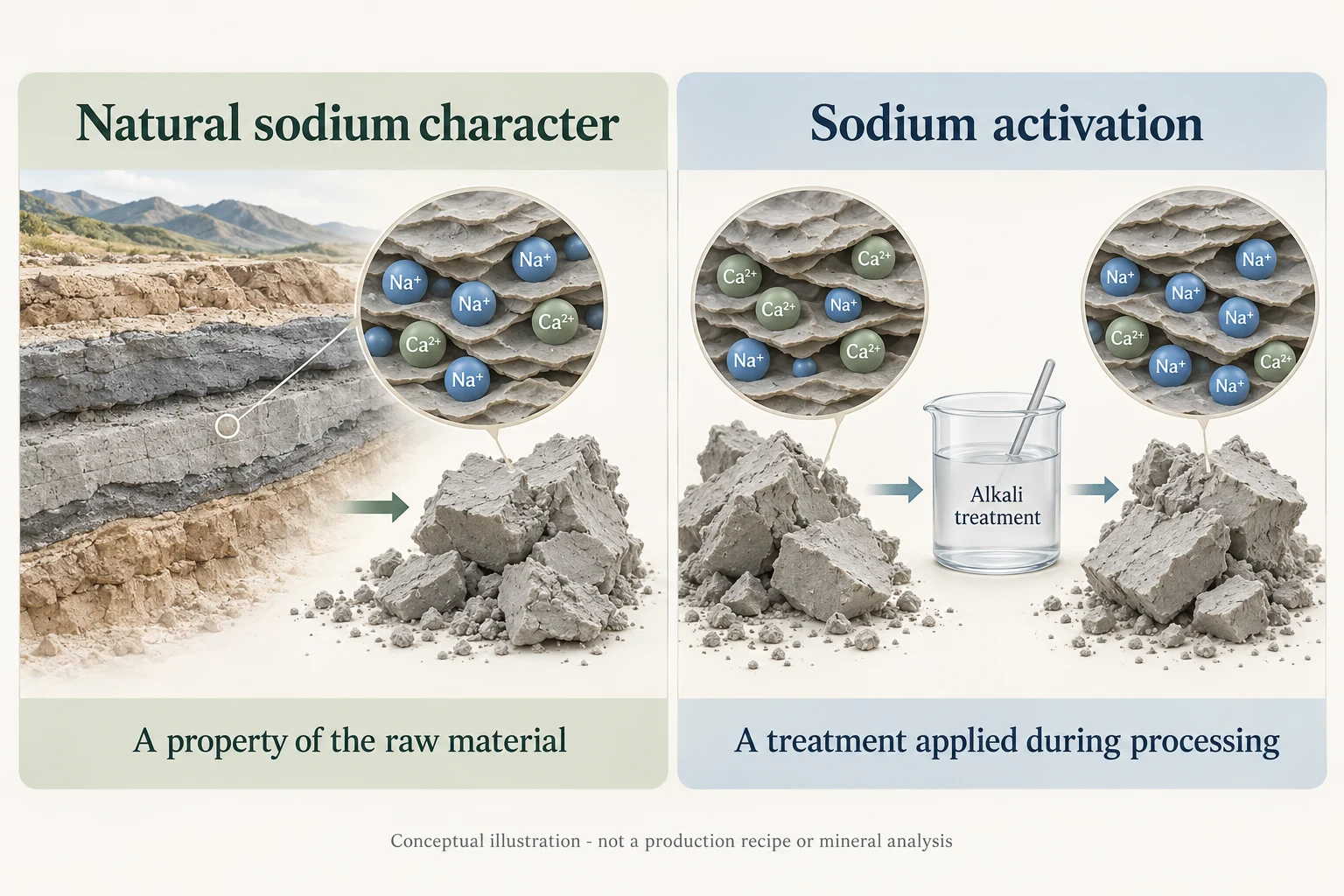
Natural sodium character describes the raw material; sodium activation describes a processing route. Conceptual illustration, not a production recipe or mineral analysis.
4. How We Connect Material Preparation with Finished Cat Litter Performance
Activation Works Together with Granulation, Drying and Screening
Our production work continues after material preparation. Granulation forms the particles used in the product; for our crushed format, formed granules subsequently pass through double-roll crushing. Drying and screening help establish the condition and size distribution of the finished granules.
These stages matter because the customer receives a granular formula, not just a mineral classification. How the granules pack, wet and contact one another influences their collective behaviour.
Moisture is part of that balance. Appropriate moisture can help limit dust release, while excess starting moisture may reduce further liquid uptake per unit weight and affect clumping. We therefore discuss moisture together with particle condition and finished-product performance.
Why We Evaluate Absorption and Clumping in the Finished Formula
Our pre-shipment process includes checks of granule condition and clumping behaviour. Absorption, formation time and clump integrity provide different information and should retain their individual meanings.
A report for one finished formula is not a controlled comparison between sodium and calcium bentonite. Without matched raw materials, preparation and test conditions, we would not use that report to claim a universal advantage for one material class.
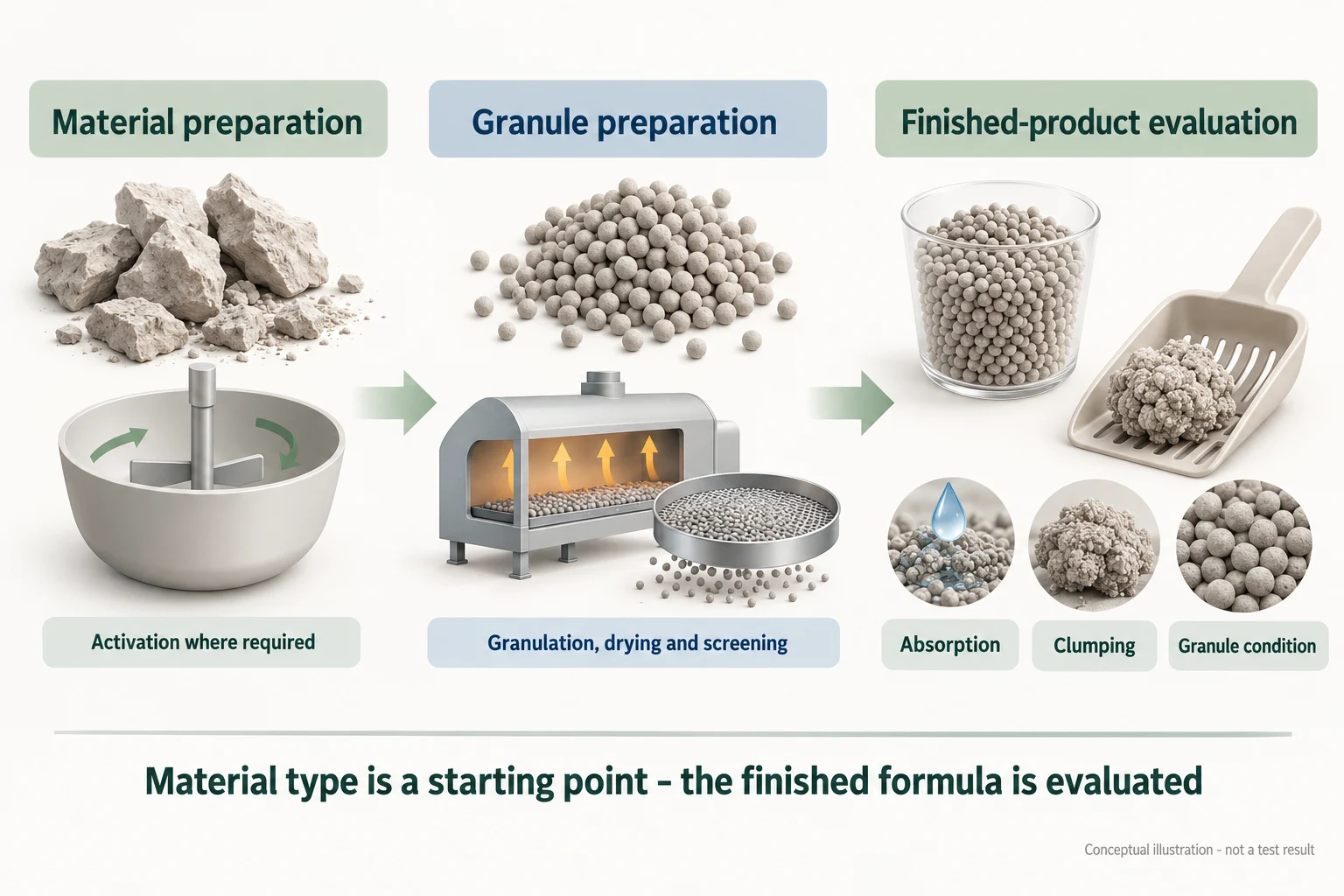
The material is a starting point. Granule preparation and evaluation connect it with the finished formula. Conceptual illustration, not an equipment photograph or test result.
5. How We Explain Common Questions About Bentonite Labels
Does “Bentonite” Alone Identify Sodium or Calcium Bentonite?
No. The broad name does not identify the predominant exchangeable ions or confirm whether sodium activation has been applied. This naming uncertainty also appears in Reddit discussions about bentonite litter labels.
We use those discussions to understand the question, not as evidence for the mineral composition or safety of a particular product. Our explanation stays connected to the material and processing information we can substantiate.
Does “Natural” Mean the Material Has Received No Processing?
A mineral can be naturally sourced and still undergo drying, milling, granulation or other preparation. Natural origin and an untreated condition are different claims.
For our products, we describe the relevant processing rather than let “natural” imply that no treatment has occurred. A photograph of grey clay or a water-pouring demonstration cannot, on its own, establish whether a sample is natural sodium bentonite or sodium-activated material.
Can Sodium or Calcium Alone Tell Us the Dust Level?
The classification alone does not establish a finished product’s dust level. Loose fines, granule strength, screening, moisture and abrasion during handling also matter.
We therefore avoid assigning an automatic dust ranking to sodium and calcium materials. Likewise, a lower visible dust release is not proof that fine particles have disappeared. Such statements need an appropriate product-specific definition and evaluation.
6. Discuss Your Bentonite Cat Litter Specifications with Our Team
For LINGSHUAI, the material distinction is the starting point of a production discussion. Raw material character, activation where required and the preparation of finished granules all contribute to the product we manufacture.
Tell our team which properties your project needs to address, including liquid uptake, clump formation, integrity during handling, dust release and formula requirements. If you already have sample-evaluation conditions, sharing them helps us discuss results on the same basis.
Contact LINGSHUAI to discuss your specifications and samples. Our business team will follow up with suitable product or formulation options for your requirements.
What Is Bentonite Cat Litter? Inside LINGSHUAI’s Materials and Production
We explain our bentonite raw material, two processing routes, granule formats an…
Read more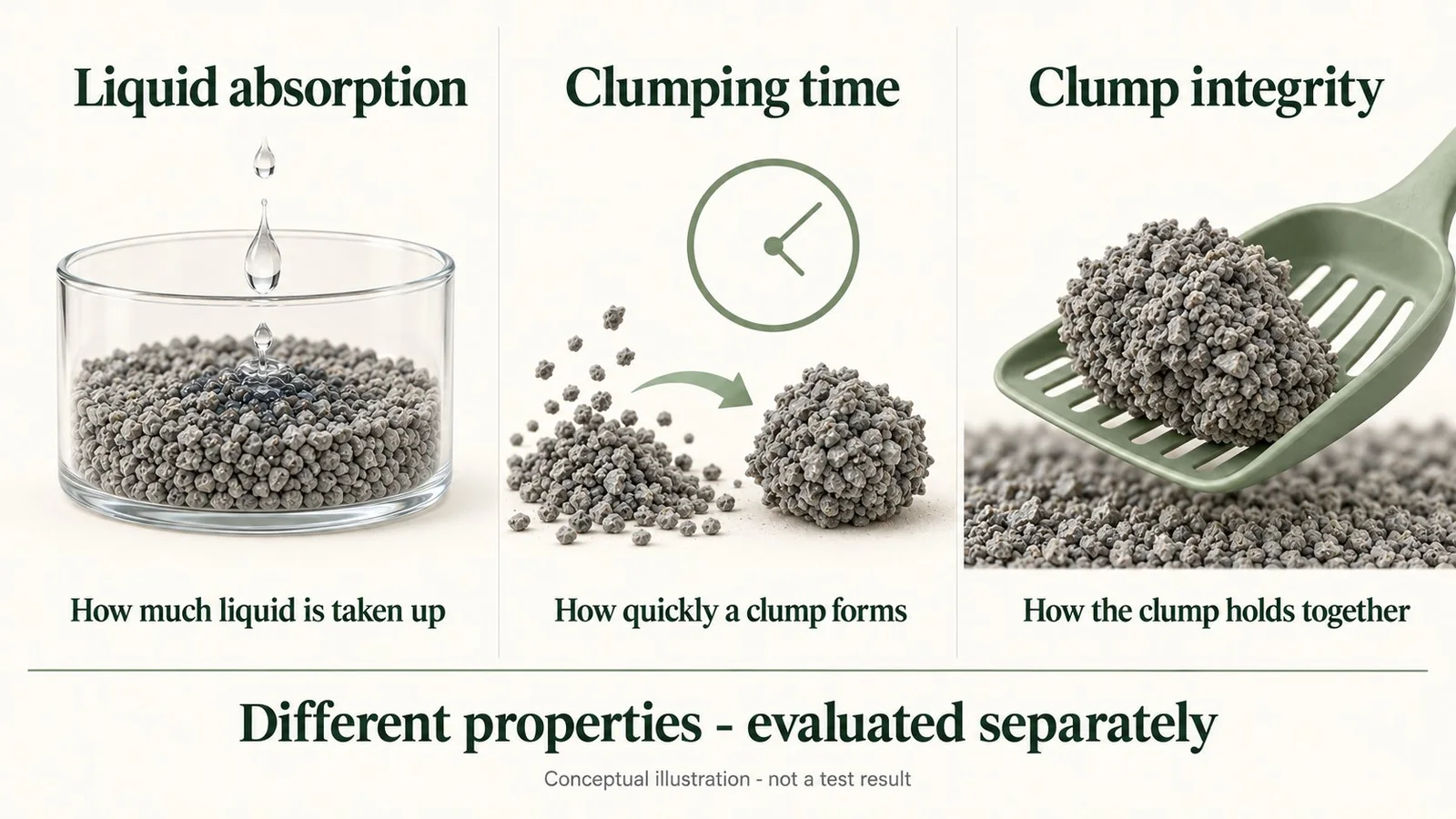
Why Does Bentonite Absorb Water and Clump? Our Manufacturing Perspective
We explain how bentonite forms clumps, how moisture affects dust and further liq…
Read more