Why Does Bentonite Absorb Water and Clump? Our Manufacturing Perspective
We explain how bentonite forms clumps, how moisture affects dust and further liquid uptake, and why we evaluate absorption, formation time and clump integrity separately.
By LINGSHUAI
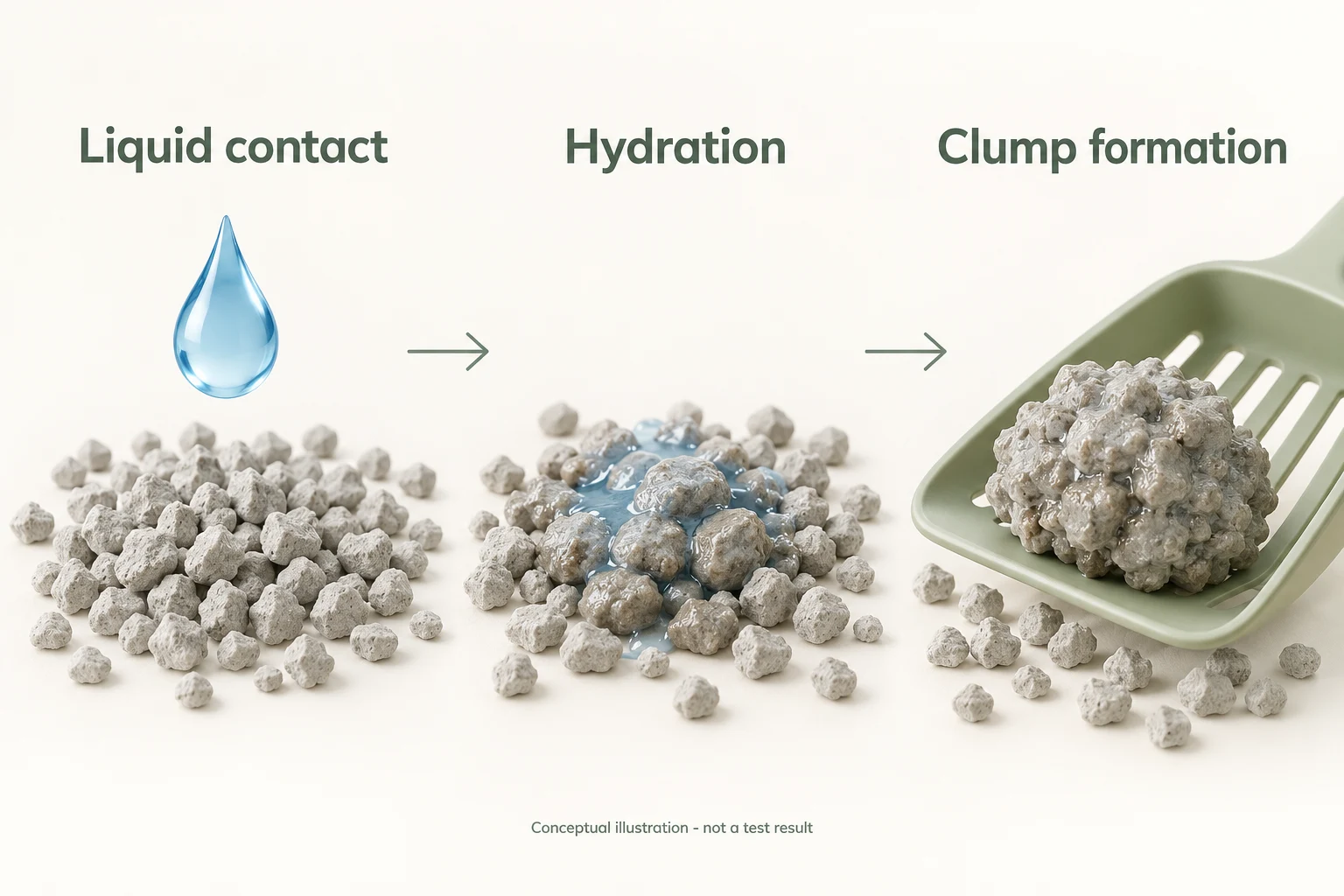
What makes cat litter clump? In our bentonite-based products, the answer starts with the clay’s interaction with water. Bentonite contains swelling clay minerals, principally montmorillonite. As liquid wets the granules, the clay hydrates and swells, and neighbouring wetted particles can bind together into a removable clump.
At LINGSHUAI, we work with this material behaviour through raw material preparation, activation where required, granulation, drying and screening. The mineral provides the basis for clumping; the finished granules and formula influence how that behaviour appears in the litter tray.
That distinction matters. Taking up liquid, forming a clump quickly and holding together during lifting are connected, but they are different properties. We consider them separately when evaluating our finished bentonite cat litter.
1. What Makes the Bentonite in Our Cat Litter Take Up Water?
The Layered Mineral Structure Behind Water Uptake
Montmorillonite has a layered structure with charged surfaces and exchangeable ions. Water interacts with those surfaces and ions, including in the spaces between mineral layers. This hydration can increase the spacing between layers and cause swelling. The WHO/IPCS technical review of bentonite describes the mineral structure and water-related properties behind this behaviour.
Water also moves through the spaces between particles and granules. A finished litter granule is therefore more than a stack of mineral layers: its size, internal structure and contact with surrounding granules also influence how liquid spreads through a sample.
How Water Changes the Clay Before a Clump Forms
When liquid reaches our bentonite litter, it wets a local area of the granule bed. Hydration changes the clay at the wetted surfaces, while swelling and particle interactions help neighbouring wet material come together.
We do not describe this simply as dry granules becoming larger. A useful clump requires connections across the wet area. The resulting mass needs enough cohesion to remain together when it is lifted.
2. How Do Wetted Bentonite Granules Become a Clump?
From Liquid Contact to Hydrated Particle Surfaces
Liquid first contacts the exposed granules and moves into the surrounding material. As the clay takes up water, the wetted region changes from loose, dry granules into a moist mass. The amount and distribution of liquid affect how much material becomes involved.
This is why an isolated granule absorbing a drop and a whole litter bed forming a clump are different observations. For our product evaluation, the behaviour of the granules together matters as much as the response of the material itself.
How Neighbouring Granules Hold Together
Hydrated clay at the contact points helps connect adjacent wetted granules. Across the wet region, these contacts form a cohesive mass that can separate from the surrounding loose litter.
The strength of that mass depends on more than the presence of bentonite. Mineral composition, processing, particle distribution, moisture and formula can all influence the result. We therefore assess the finished product rather than infer its full performance from the raw material name.
An early visible clump also does not necessarily have the same handling strength as it will after a longer waiting period. We keep the evaluation time clear when comparing samples.
Conceptual illustration of clump formation; not a microscope image or a measured test result.
3. Why Sodium Activation Matters in Our Bentonite Processing
How Exchangeable Ions Affect Swelling Behaviour
The ions associated with the clay influence its interaction with water. Sodium-dominant and calcium-dominant bentonites can behave differently; sodium-dominant material generally has greater swelling potential in fresh water. Liquid composition also matters, so a water demonstration should not be treated as a universal prediction for every liquid and use condition.
For our work, this means “bentonite” identifies a material family, while the selected raw material and its treatment help determine the behaviour available to the finished formula.
How We Apply Sodium Activation Where the Process Requires It
Our documented production routes include alkali treatment of calcium bentonite for sodium activation where required. This treatment changes the clay’s exchangeable-ion balance to develop the material for the intended process and product.
We therefore describe the material and its preparation accurately, rather than call every LINGSHUAI product untreated natural sodium bentonite. Activation is one part of production: granulation, drying and screening still contribute to the condition of the finished litter.
4. How We Balance Moisture, Dust and Clumping Performance
Why Higher Moisture Can Reduce Dust Release
Finished cat litter already contains some moisture before additional liquid reaches it. That starting moisture can influence both handling and absorption.
Within a suitable range, increasing moisture can help fine particles adhere to larger particles and reduce their tendency to become airborne. However, reduced visible dust does not mean the fines have disappeared. Granule strength, screening and abrasion during handling also affect how much dust is released. Bulk-handling equipment manufacturer KWS describes bentonite as both dusty when dry and potentially sticky when moist, illustrating why its handling properties change with moisture.
At LINGSHUAI, we consider moisture alongside the physical condition of the granules. Adding water alone does not replace control of loose fines or prevent weak granules from breaking during handling.
How Excess Moisture Can Affect Further Liquid Uptake and Clumping
Higher starting moisture can reduce the additional liquid uptake available per unit weight of finished product. Part of that product weight is already water, and the clay is already partly hydrated. The measured effect depends on the material, formula and absorption method.
Excess moisture can also alter how the granules wet, bind and handle. A formulation may show a change in clump formation or integrity as its moisture rises. This is not a fixed, identical relationship for every bentonite product, and it does not establish one moisture percentage that suits all formulas.
The production question is therefore practical: can we reduce dust release while retaining the required absorption and clumping behaviour? We evaluate these properties together instead of treating a higher moisture reading as an automatic improvement.
Why We Assess Moisture Together with Granule Size and Condition
Our drying and screening stages help prepare the finished granules. Particle-size distribution influences how granules pack and contact one another, while granule condition influences the fines present or generated during handling.
We review those factors alongside moisture, pouring-dust observations and clumping checks. A sample that looks less dusty still needs to demonstrate suitable liquid uptake and clump formation. Equally, drying further is not automatically beneficial if the resulting material releases more fines or handles poorly.
Our aim is a balance appropriate to the product specification. This is a manufacturing consideration, not a recommendation to add water to packaged litter.
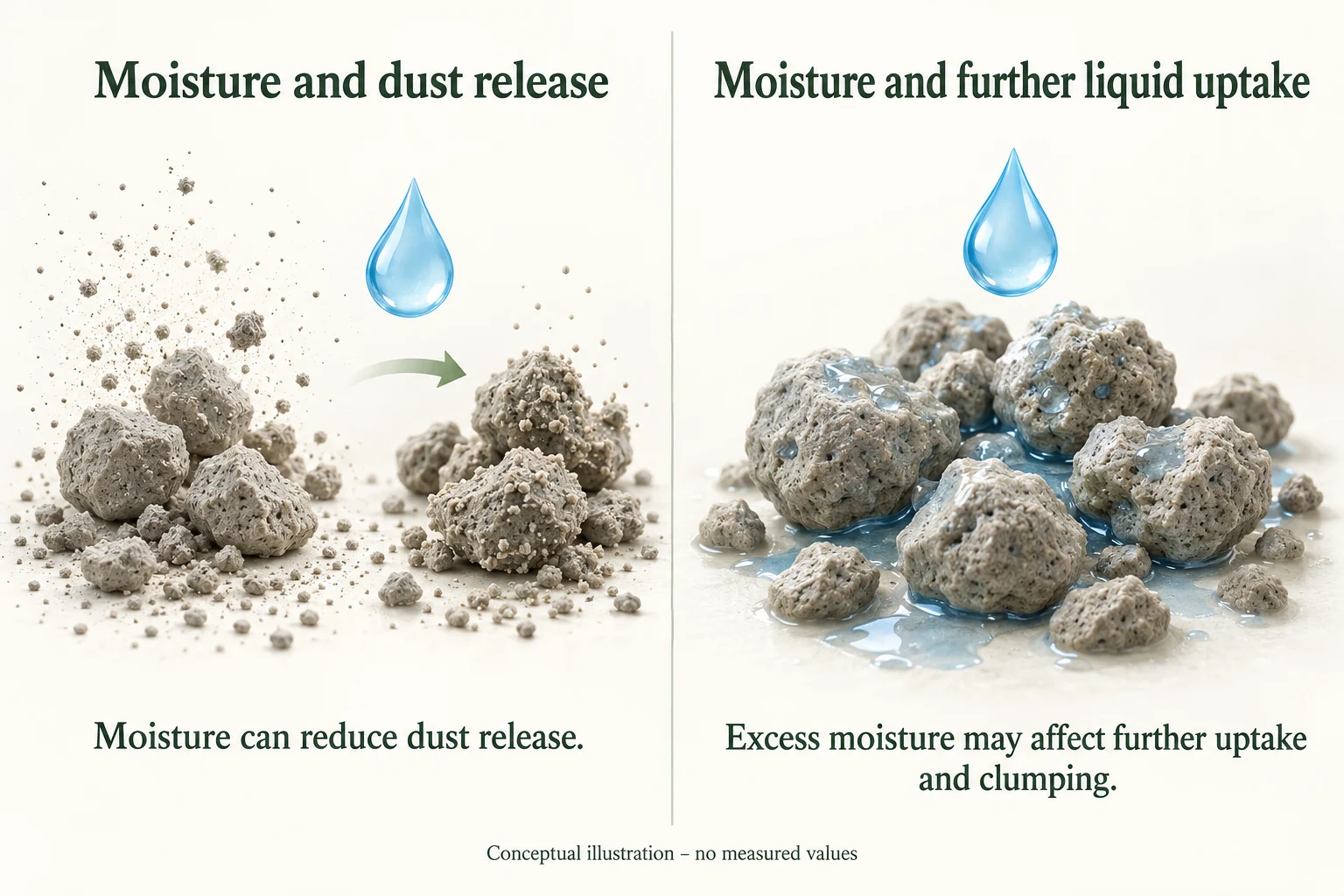
Moisture may reduce dust release, while excess moisture may affect further uptake and clumping. Conceptual illustration; no measured values.
5. Why We Check Absorption, Clumping Time and Clump Integrity Separately
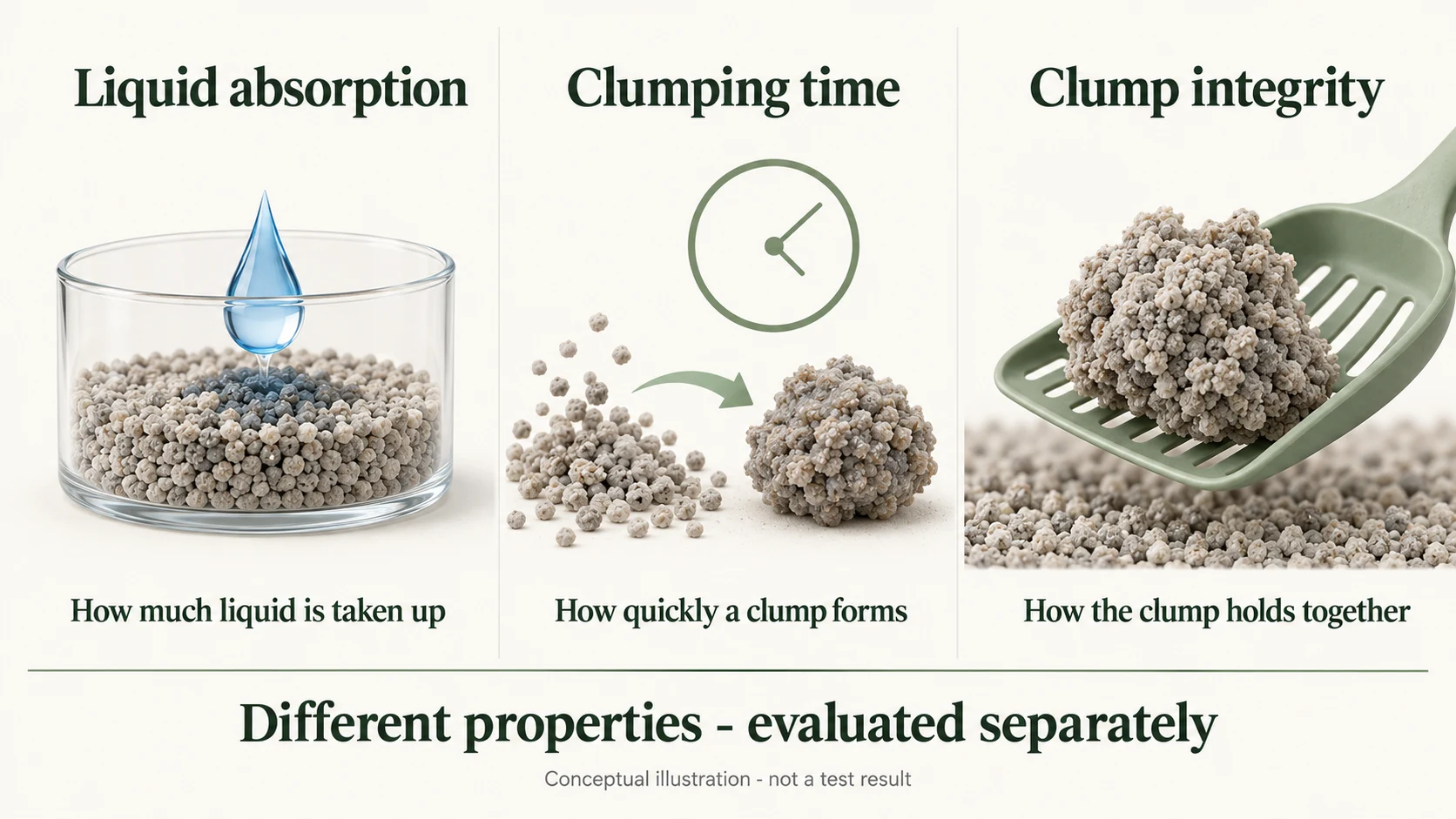
Liquid uptake, formation speed and handling integrity answer different questions. Conceptual illustration; not a test result.
These checks answer different questions about the finished material:
| Property | What it tells us | What it does not establish by itself |
|---|---|---|
| Liquid absorption | How much liquid the sample takes up under a stated method | How strong the resulting clump will be |
| Clumping time | How quickly a clump forms under the evaluation conditions | How it will withstand lifting or later disturbance |
| Clump integrity | How the formed clump holds together during a defined handling check | The sample’s total absorption capacity |
We use the actual item names and methods when referring to a product report. An absorption percentage is not a clump-strength score, and a short reported clumping time is not a guarantee that every freshly wetted clump can immediately withstand handling.
Every batch also goes through our pre-shipment inspection process, including checks of clumping behaviour and granule condition. Product-specific third-party reports and routine shipment checks have different roles; we do not present a report for one tested sample as a new report for every batch.
6. How We Investigate a Clump That Forms but Breaks Apart
The Liquid, Dose and Waiting Time Used in the Evaluation
A sample can appear clumped while still breaking into pieces when lifted. This question also appears in Reddit discussions about changes in clumping performance. Those experiences help identify useful questions, but they do not establish the cause for a particular product.
When reviewing such a result, we first clarify the conditions: which liquid was used, how much was added, how it was applied and how long the sample stood before lifting. Bed depth and whether the wetted material reached the tray bottom also affect the situation being evaluated.
Keeping these conditions consistent helps us separate a product difference from a difference in the evaluation itself.
Granule Condition and the Way the Clump Is Lifted
We also review the sample’s moisture, particle distribution and physical condition. Where relevant, we examine whether storage or handling has changed the sample since production.
The lifting action matters because it applies force to the clump. Lifting a supported mass, pulling material away from a tray surface and shaking it impose different stresses. We distinguish those observations when discussing results.
Our purpose is to understand where the clump loses integrity and whether material, processing, formula or evaluation conditions contribute. We do not assume every broken clump is caused by the way it was used, or that higher absorption alone will resolve it.
7. Discuss Clumping Requirements with Our LINGSHUAI Team
Bentonite’s interaction with water provides the foundation for our clumping litter. Our manufacturing work turns that foundation into finished granules, balancing material preparation, particle condition, moisture and formula.
If you are discussing a bentonite litter project with us, tell our team which properties matter to your specification: liquid uptake, formation speed, clump integrity, dust release or a combination of these. Where you have sample-evaluation conditions, sharing them helps us discuss the results on the same basis.
Contact our LINGSHUAI team to discuss the product specification, samples and suitable evaluation arrangements for your project.
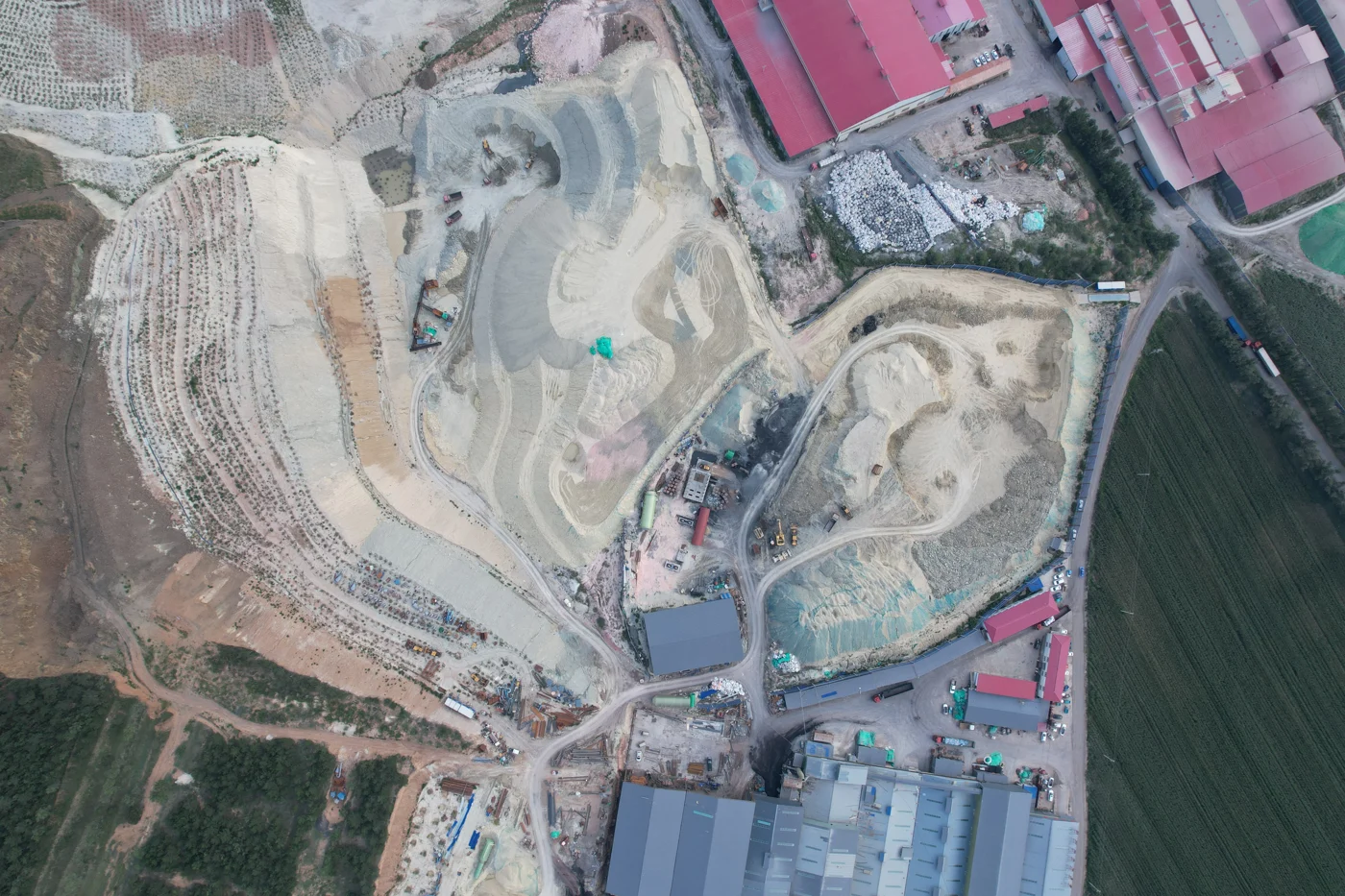
What Is Bentonite Cat Litter? Inside LINGSHUAI’s Materials and Production
We explain our bentonite raw material, two processing routes, granule formats an…
Read moreFrom Bentonite Mine to Finished Cat Litter: LINGSHUAI Factory Supply
We explain how our own mineral resources, drying equipment, granulation and ship…
Read more