Mengapa Bentonit Menyerap Air dan Menggumpal? Perspektif Produksi Kami
Kami menjelaskan hidrasi bentonit, keseimbangan kadar air dengan debu dan penyerapan tambahan, serta perbedaan daya serap, waktu penggumpalan, dan keutuhan gumpalan.
Oleh LINGSHUAI
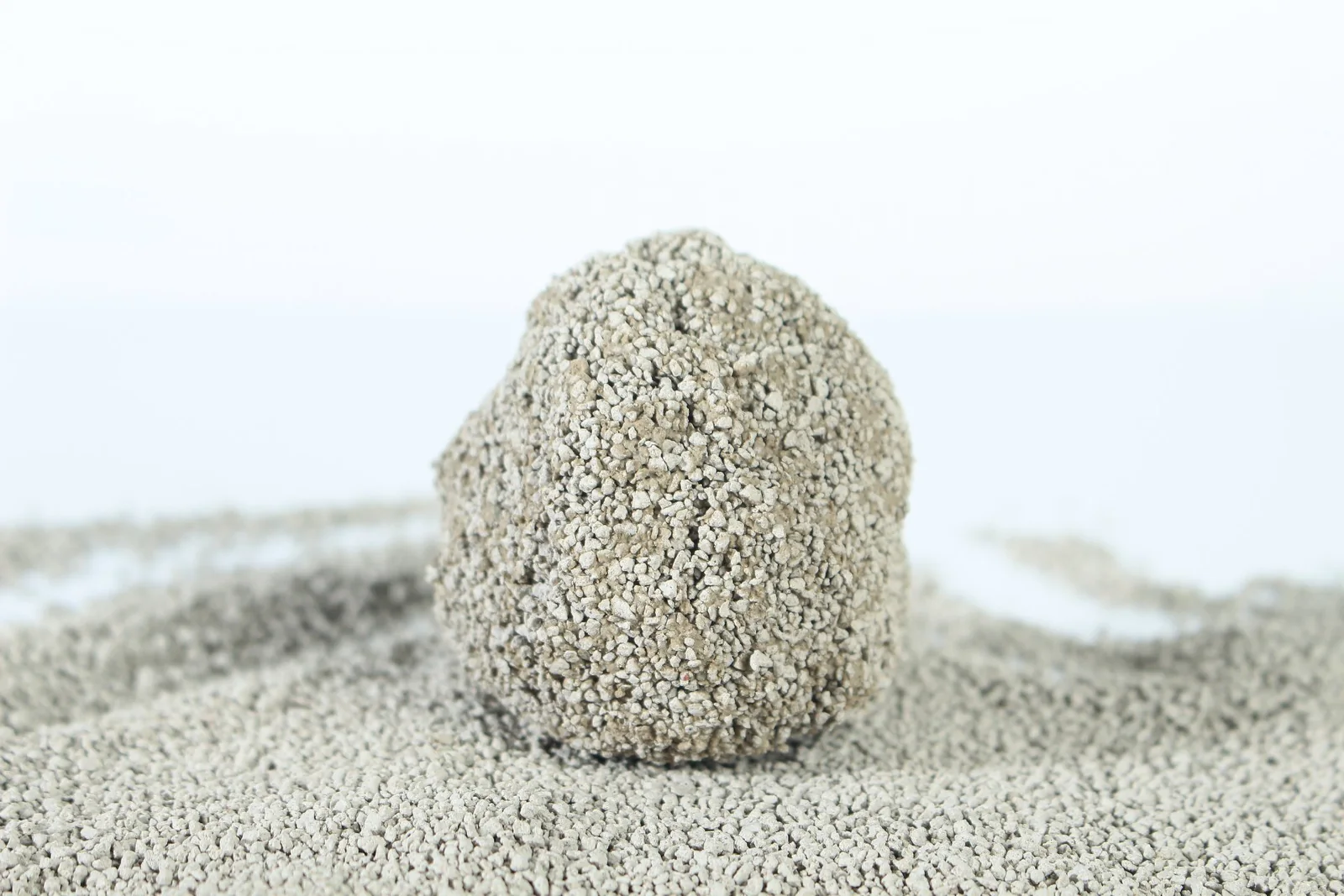
Apa yang membuat pasir kucing menggumpal? Pada produk berbasis bentonit kami, jawabannya dimulai dari interaksi lempung dengan air. Bentonit mengandung mineral lempung yang mengembang, terutama montmorilonit. Ketika cairan membasahi butiran, lempung terhidrasi dan mengembang; partikel basah yang berdekatan dapat menyatu menjadi gumpalan yang bisa diangkat.
Di LINGSHUAI, kami memanfaatkan sifat tersebut melalui persiapan bahan baku, aktivasi bila diperlukan, granulasi, pengeringan, dan pengayakan. Mineral menyediakan dasar penggumpalan, sedangkan kondisi butiran jadi dan formulanya memengaruhi perilaku di kotak pasir.
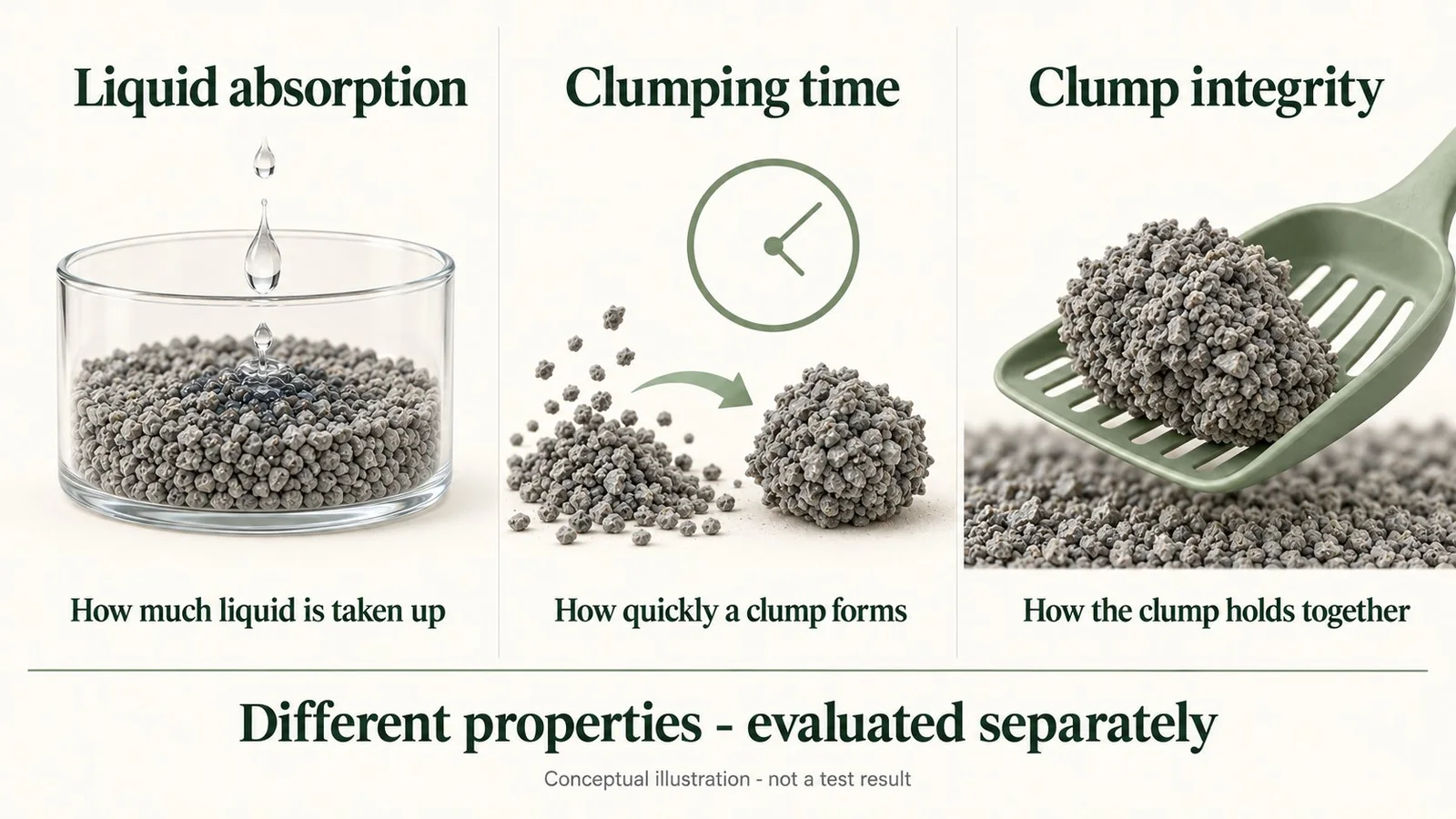
Perbedaan ini penting. Menyerap cairan, cepat membentuk gumpalan, dan tetap utuh saat diangkat saling berkaitan, tetapi merupakan sifat berbeda. Kami menilainya secara terpisah pada pasir bentonit jadi.
1. Mengapa Bentonit dalam Pasir Kami Menyerap Air?
Struktur Mineral Berlapis di Balik Penyerapan Air
Montmorilonit memiliki struktur berlapis dengan permukaan bermuatan dan ion yang dapat dipertukarkan. Air berinteraksi dengan permukaan dan ion tersebut, termasuk di antara lapisan mineral. Hidrasi dapat memperlebar jarak antarlapisan dan menyebabkan pengembangan. Tinjauan teknis WHO/IPCS tentang bentonit menjelaskan struktur dan sifat terkait air ini.
Air juga bergerak melalui ruang di antara partikel dan butiran. Butiran jadi bukan sekadar tumpukan lapisan mineral: ukuran, struktur internal, dan kontak dengan butiran sekitarnya turut memengaruhi penyebaran cairan dalam sampel.
Bagaimana Air Mengubah Lempung Sebelum Gumpalan Terbentuk
Saat cairan mencapai pasir bentonit kami, cairan membasahi area setempat pada lapisan butiran. Hidrasi mengubah lempung di permukaan basah; pengembangan dan interaksi antarpartikel membantu material basah yang berdekatan menyatu.
Kami tidak menjelaskannya hanya sebagai butiran kering yang membesar. Gumpalan yang berguna memerlukan hubungan di seluruh area basah dan kohesi yang cukup agar tetap menyatu ketika diangkat.
2. Bagaimana Butiran Bentonit Basah Menjadi Gumpalan?
Dari Kontak Cairan ke Hidrasi Permukaan
Cairan mula-mula menyentuh butiran yang terbuka lalu bergerak ke material sekitarnya. Saat lempung menyerap air, area tersebut berubah dari butiran kering yang lepas menjadi massa lembap. Jumlah dan distribusi cairan menentukan seberapa banyak material yang terlibat.
Karena itu, satu butiran yang menyerap setetes cairan berbeda dengan seluruh lapisan pasir yang membentuk gumpalan. Dalam evaluasi produk, perilaku bersama ant butiran sama pentingnya dengan respons material itu sendiri.
Bagaimana Butiran yang Berdekatan Tetap Menyatu
Lempung terhidrasi pada titik kontak membantu menghubungkan butiran basah yang berdekatan. Hubungan ini membentuk massa kohesif di area basah yang dapat dipisahkan dari pasir lepas di sekitarnya.
Kekuatan massa tersebut tidak hanya bergantung pada keberadaan bentonit. Komposisi mineral, pengolahan, distribusi partikel, kadar air, dan formula dapat memengaruhi hasil. Kami menilai produk jadi, bukan menyimpulkan seluruh kinerjanya dari nama bahan baku.
Gumpalan yang baru terlihat belum tentu memiliki ketahanan penanganan yang sama seperti setelah menunggu lebih lama. Kami memperjelas waktu evaluasi saat membandingkan sampel.
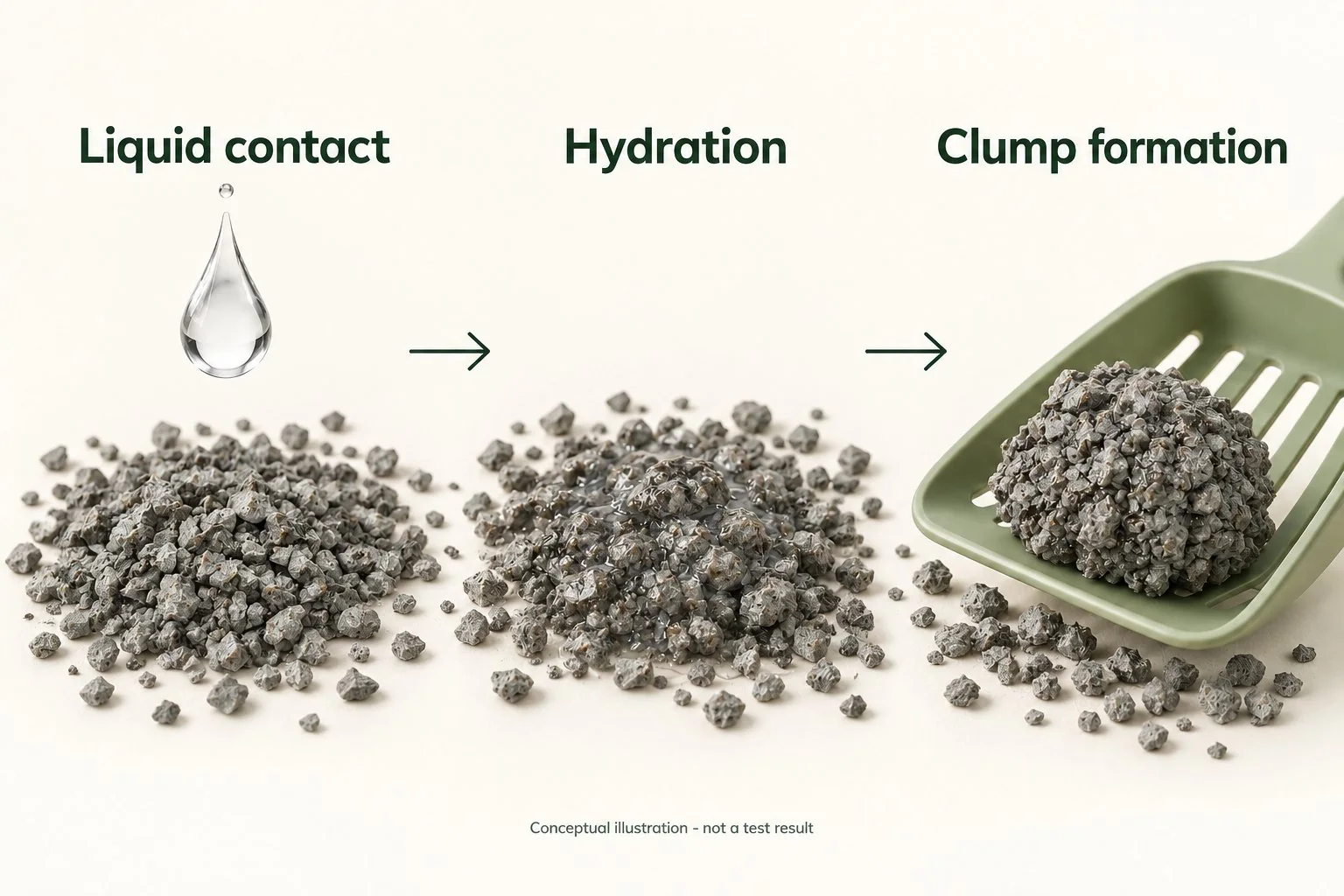
Conceptual illustration of clump formation; not a microscope image or a measured test result.
3. Why Sodium Activation Matters in Our Bentonite Processing
How Exchangeable Ions Affect Swelling Behaviour
The ions associated with the clay influence its interaction with water. Sodium-dominant and calcium-dominant bentonites can behave differently; sodium-dominant material generally has greater swelling potential in fresh water. Liquid composition also matters, so a water demonstration should not be treated as a universal prediction for every liquid and use condition.
For our work, this means “bentonite” identifies a material family, while the selected raw material and its treatment help determine the behaviour available to the finished formula.
How We Apply Sodium Activation Where the Process Requires It
Our documented production routes include alkali treatment of calcium bentonite for sodium activation where required. This treatment changes the clay’s exchangeable-ion balance to develop the material for the intended process and product.
We therefore describe the material and its preparation accurately, rather than call every LINGSHUAI product untreated natural sodium bentonite. Activation is one part of production: granulation, drying and screening still contribute to the condition of the finished litter.
4. How We Balance Moisture, Dust and Clumping Performance
Why Higher Moisture Can Reduce Dust Release
Finished cat litter already contains some moisture before additional liquid reaches it. That starting moisture can influence both handling and absorption.
Within a suitable range, increasing moisture can help fine particles adhere to larger particles and reduce their tendency to become airborne. However, reduced visible dust does not mean the fines have disappeared. Granule strength, screening and abrasion during handling also affect how much dust is released. Bulk-handling equipment manufacturer KWS describes bentonite as both dusty when dry and potentially sticky when moist, illustrating why its handling properties change with moisture.
At LINGSHUAI, we consider moisture alongside the physical condition of the granules. Adding water alone does not replace control of loose fines or prevent weak granules from breaking during handling.
How Excess Moisture Can Affect Further Liquid Uptake and Clumping
Higher starting moisture can reduce the additional liquid uptake available per unit weight of finished product. Part of that product weight is already water, and the clay is already partly hydrated. The measured effect depends on the material, formula and absorption method.
Excess moisture can also alter how the granules wet, bind and handle. A formulation may show a change in clump formation or integrity as its moisture rises. This is not a fixed, identical relationship for every bentonite product, and it does not establish one moisture percentage that suits all formulas.
The production question is therefore practical: can we reduce dust release while retaining the required absorption and clumping behaviour? We evaluate these properties together instead of treating a higher moisture reading as an automatic improvement.
Why We Assess Moisture Together with Granule Size and Condition
Our drying and screening stages help prepare the finished granules. Particle-size distribution influences how granules pack and contact one another, while granule condition influences the fines present or generated during handling.
We review those factors alongside moisture, pouring-dust observations and clumping checks. A sample that looks less dusty still needs to demonstrate suitable liquid uptake and clump formation. Equally, drying further is not automatically beneficial if the resulting material releases more fines or handles poorly.
Our aim is a balance appropriate to the product specification. This is a manufacturing consideration, not a recommendation to add water to packaged litter.
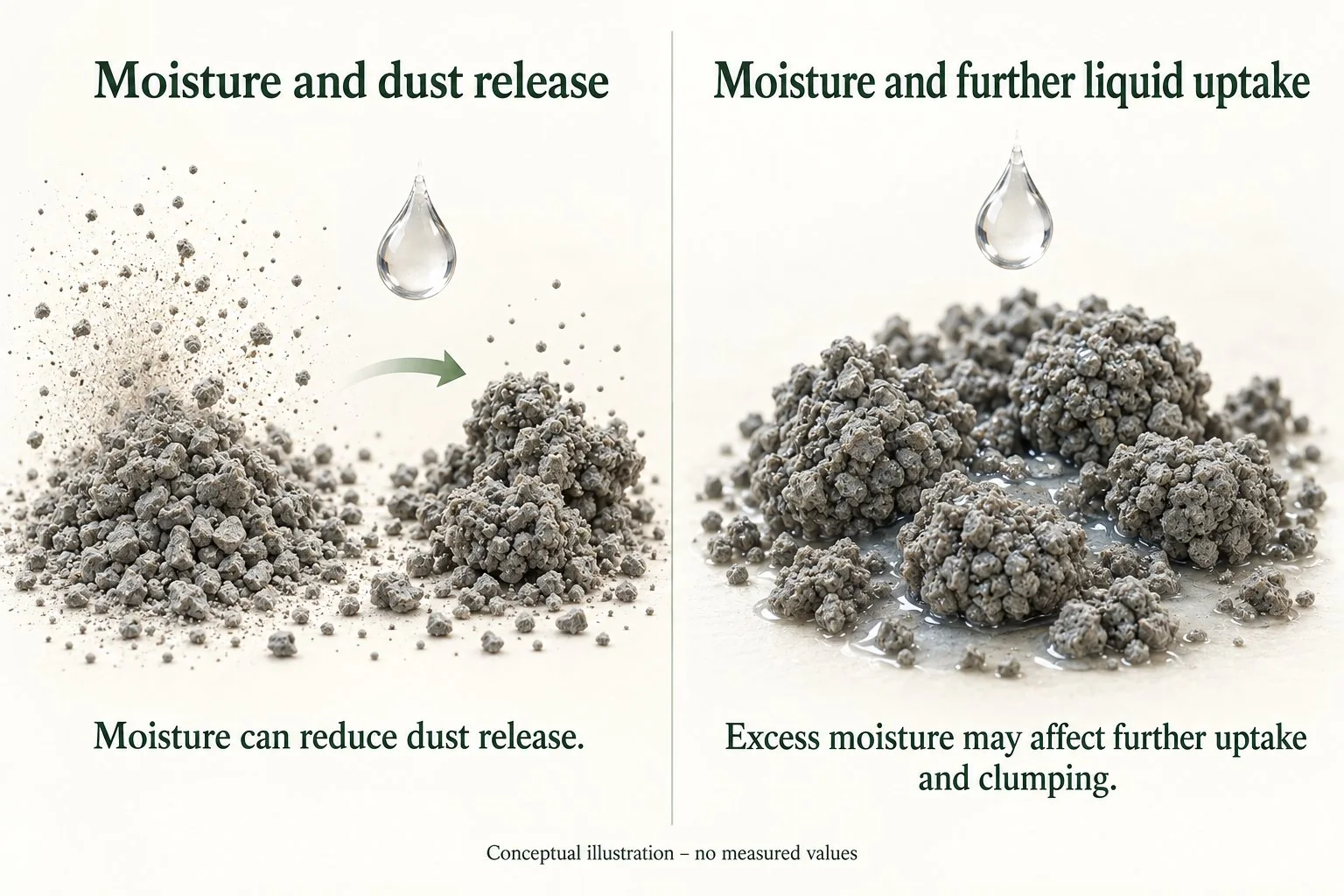
Moisture may reduce dust release, while excess moisture may affect further uptake and clumping. Conceptual illustration; no measured values.
5. Why We Check Absorption, Clumping Time and Clump Integrity Separately
These checks answer different questions about the finished material:
| Property | What it tells us | What it does not establish by itself |
|---|---|---|
| Liquid absorption | How much liquid the sample takes up under a stated method | How strong the resulting clump will be |
| Clumping time | How quickly a clump forms under the evaluation conditions | How it will withstand lifting or later disturbance |
| Clump integrity | How the formed clump holds together during a defined handling check | The sample’s total absorption capacity |
We use the actual item names and methods when referring to a product report. An absorption percentage is not a clump-strength score, and a short reported clumping time is not a guarantee that every freshly wetted clump can immediately withstand handling.
Every batch also goes through our pre-shipment inspection process, including checks of clumping behaviour and granule condition. Product-specific third-party reports and routine shipment checks have different roles; we do not present a report for one tested sample as a new report for every batch.
6. How We Investigate a Clump That Forms but Breaks Apart
The Liquid, Dose and Waiting Time Used in the Evaluation
A sample can appear clumped while still breaking into pieces when lifted. This question also appears in Reddit discussions about changes in clumping performance. Those experiences help identify useful questions, but they do not establish the cause for a particular product.
When reviewing such a result, we first clarify the conditions: which liquid was used, how much was added, how it was applied and how long the sample stood before lifting. Bed depth and whether the wetted material reached the tray bottom also affect the situation being evaluated.
Keeping these conditions consistent helps us separate a product difference from a difference in the evaluation itself.
Granule Condition and the Way the Clump Is Lifted
We also review the sample’s moisture, particle distribution and physical condition. Where relevant, we examine whether storage or handling has changed the sample since production.
The lifting action matters because it applies force to the clump. Lifting a supported mass, pulling material away from a tray surface and shaking it impose different stresses. We distinguish those observations when discussing results.
Our purpose is to understand where the clump loses integrity and whether material, processing, formula or evaluation conditions contribute. We do not assume every broken clump is caused by the way it was used, or that higher absorption alone will resolve it.
7. Discuss Clumping Requirements with Our LINGSHUAI Team
Bentonite’s interaction with water provides the foundation for our clumping litter. Our manufacturing work turns that foundation into finished granules, balancing material preparation, particle condition, moisture and formula.
If you are discussing a bentonite litter project with us, tell our team which properties matter to your specification: liquid uptake, formation speed, clump integrity, dust release or a combination of these. Where you have sample-evaluation conditions, sharing them helps us discuss the results on the same basis.
Contact our LINGSHUAI team to discuss the product specification, samples and suitable evaluation arrangements for your project.