What Are the Main Sources of Dust in Cat Litter?
Trace cat litter dust from raw materials and powdered ingredients to processing, moisture, transport and use. See how fines differ from airborne dust.
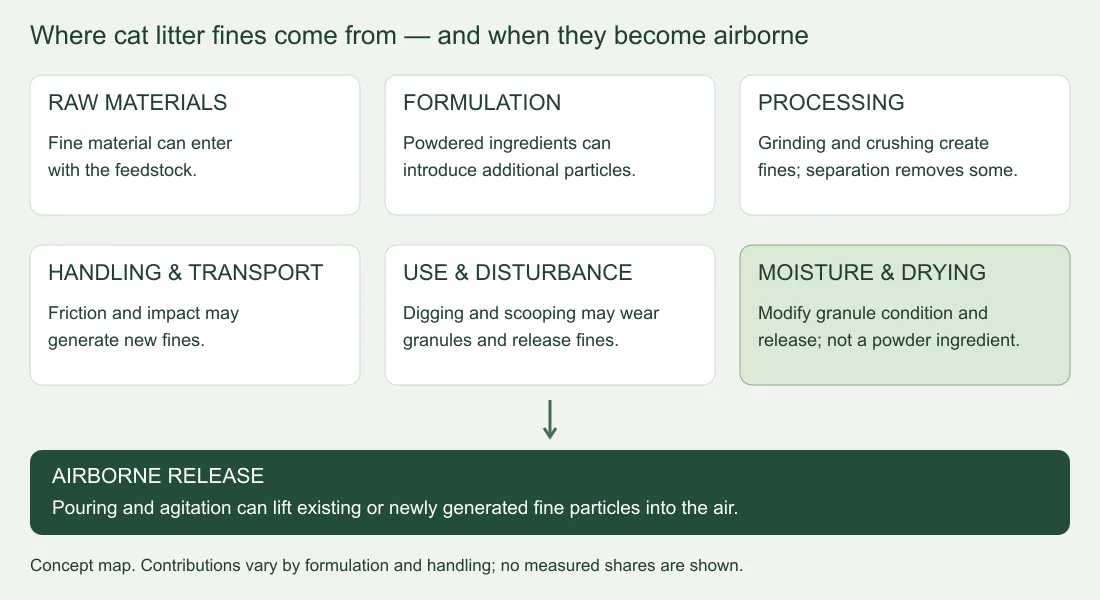
Cat litter dust can come from fine material already present in the raw ingredients, fines generated or left behind during processing, powder introduced through ingredients such as powdered fragrance, and new fines created by friction and impact during filling, transport and use. Drying conditions and moisture content also affect granule condition and dust release. Raw materials or incomplete screening alone cannot explain every dust issue.
At LINGSHUAI, we follow our bentonite litter from raw materials and formulation through forming, crushing, drying and screening, then packaging, transport and use. We distinguish how fine particles enter or develop in the product from the conditions that release them into the air. Powder in a bag, dust during pouring and granules outside a tray describe different observations, so reviewing a dust issue starts by identifying which one is being reported.
1. Are Loose Fines and Airborne Dust the Same Thing?
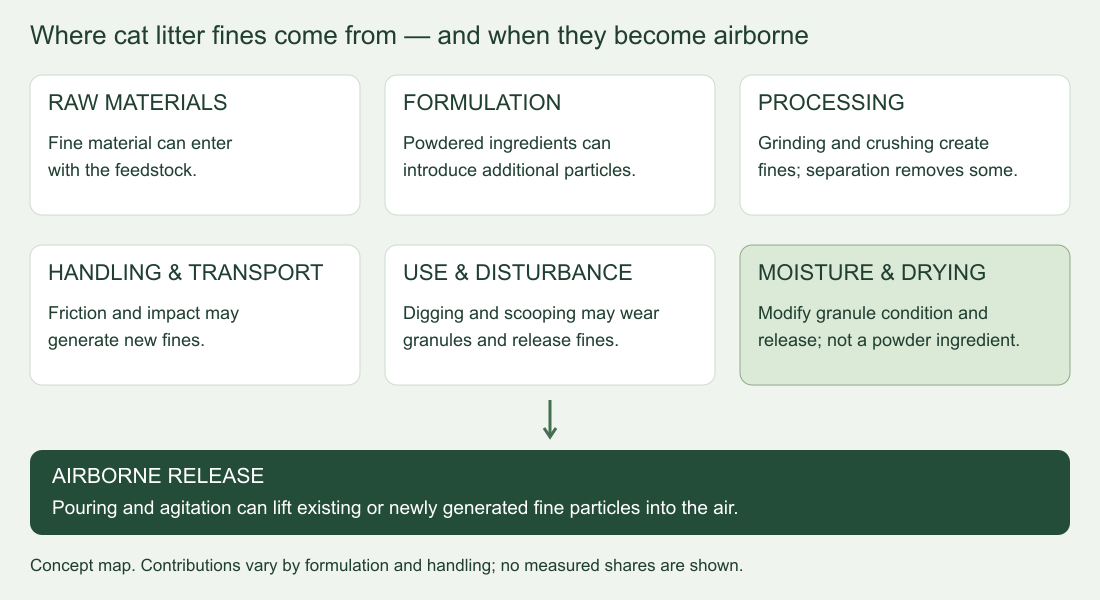
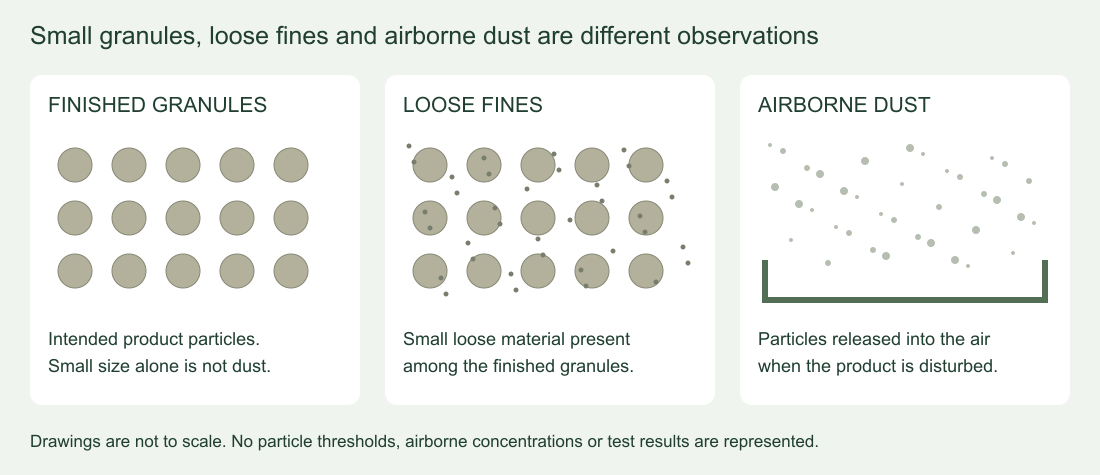
Loose fines are small particles within the product. Airborne dust is material released into the air when the product is disturbed. They are related, but measuring one does not automatically measure the other.
How Do Small Granules, Loose Fines and Airborne Dust Differ?
A small finished granule may be an intended part of the size specification. Loose fines are a separate fraction, defined by the relevant measurement method. During pouring, some loose material may become airborne while other particles settle quickly. Particle size alone does not describe the entire release behaviour.
Does Litter Tracking Mean There Is More Dust?
Granules carried out on paws or fur, or scattered during digging, indicate tracking. They do not establish an airborne-dust concentration. A complaint about gritty floors therefore raises a different question from a visible cloud during pouring. Keeping these observations separate makes it possible to trace their causes.
2. What Fine Material Can Come from Raw Materials and Formulations?
Not all loose powder begins with a finished granule breaking. Fine feedstock and powdered formulation ingredients can also contribute material that needs to be incorporated or separated during production.
Why Are Fines in Bentonite Feedstock Different from Fines in Finished Litter?
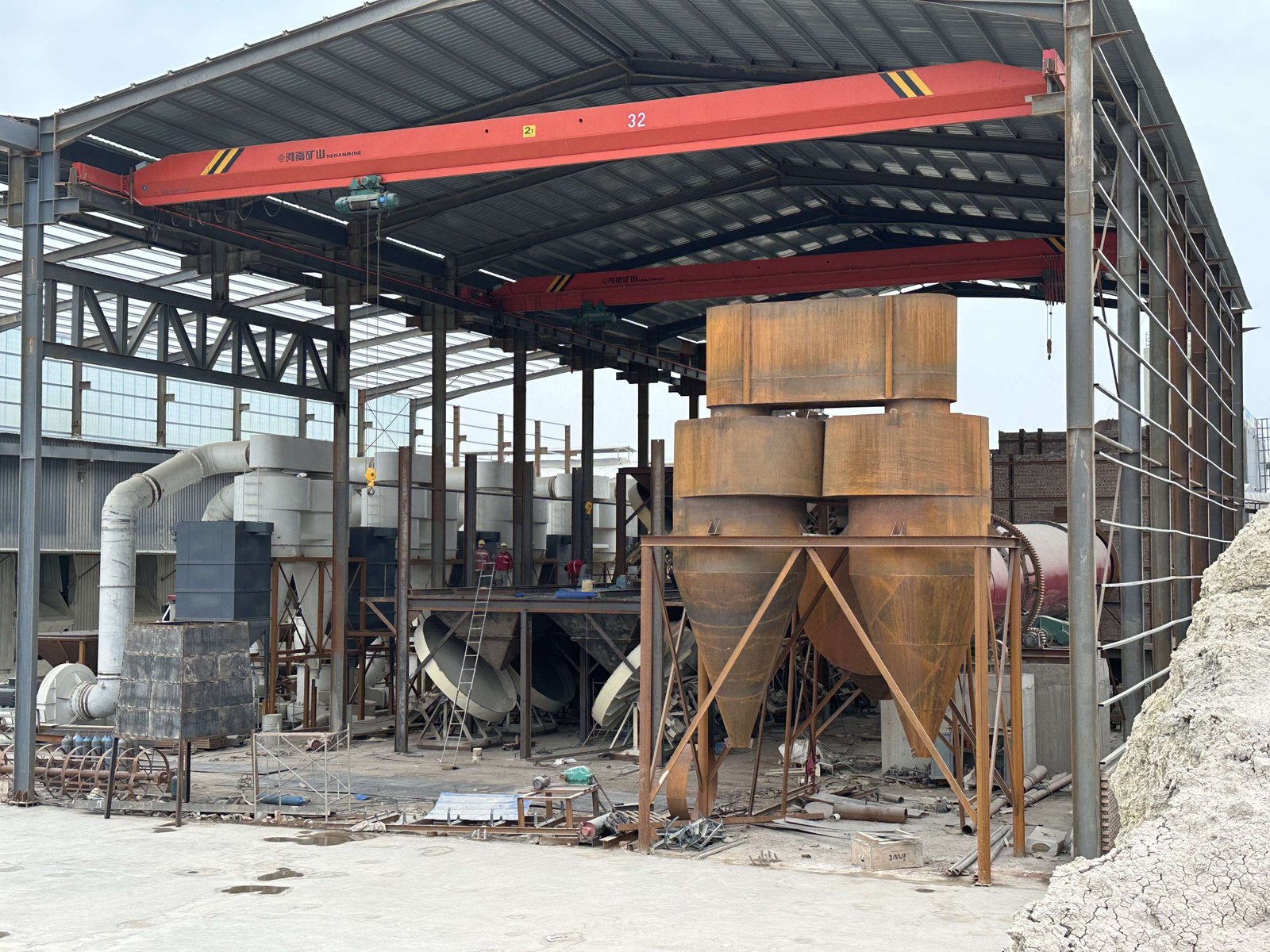
Grinding can prepare bentonite for forming. Fine material at that stage may be an intended intermediate rather than an unwanted finished-product residue. The important question is what happens next: whether it becomes part of a formed granule or remains loose in the finished product. A photograph of ground feedstock cannot establish the dust performance of bagged litter.
Can Powdered Fragrance and Other Ingredients Add to Dust?
Our formulation knowledge distinguishes powdered fragrance from oil-based liquid fragrance. Powdered fragrance can increase dust, and we generally use oil-based liquid fragrance as the main fragrance type. The actual contribution depends on the selected ingredient and how it is incorporated.
Other ingredients also need to be considered according to their supplied form and behaviour. We do not assume that every additive creates dust, or that every coloured or dark particle is loose powder. This makes formulation part of source analysis before mechanical wear is considered.
3. Which Manufacturing Steps Generate or Release Fines?
Manufacturing can create fine material intentionally during size reduction and unintentionally through particle damage. Forming granules, removing existing fines and limiting later wear address different parts of that chain.
What Happens to Fines Created During Grinding and Crushing?
Grinding prepares material for subsequent processing; crushing changes formed particles into smaller fragments and creates a distribution of sizes. In our documented crushed-litter route, pan granulation comes before double-roll crushing. The intermediate granules are formed first, then broken into irregular pieces before drying and screening.
Screening selects the target size fraction. Material outside that fraction must be distinguished from the finished specification rather than treated as evidence that every crushed granule is dusty.
Why Does Granule Integrity Affect Later Dust Generation?
A granule that sheds material or fractures under handling can generate new fines after an earlier separation step. Its forming condition, structure, moisture and subsequent handling all matter. Similar-looking particles may therefore behave differently during transfer or transport.
How Do Screening, Dust Collection and Reduced Abrasion Differ?
Screening separates particle sizes. Dust collection manages particles released at relevant production stages. Reducing abrasion addresses the creation of additional fines. Our documented process includes dust collection at relevant forming, drying, screening and filling stages; this does not imply a single removal percentage for every product.
Removing existing fines is only part of the explanation. The condition of the granules leaving the dryer also influences what may happen later.
4. How Do Drying and Moisture Content Affect Cat Litter Dust?
Moisture affects particle condition and dust release. Our objective is a suitable finished-product balance, rather than the driest possible granule or simply adding moisture to hide visible dust.
Can Excessive Drying Make Granules More Prone to Shedding Fines?
In some formulations, excessive or uneven drying can leave particles more vulnerable to surface shedding or damage during handling. That possibility needs to be evaluated with the actual material. A dusty pour alone does not prove overdrying: existing fines, formulation ingredients and mechanical wear remain alternative explanations.
Why Can Higher Moisture Reduce Dust but Still Create Trade-Offs?
Increasing moisture can help reduce dust release in some products, but it changes their starting condition. It may reduce further liquid uptake or affect clump formation; excessive moisture can also complicate storage and handling. We therefore consider moisture together with absorption and clump behaviour, rather than treating lower visible dust as the sole objective.
There is no universal moisture target established here. The appropriate specification depends on the formulation and verification. Once packaged, the product faces another source of change: movement and impact.
5. Why Can Packaging and Transport Add Fines After Production?
Packaging and transport can generate fines through wear and can redistribute fine material already present. These processes may occur together, so powder at the bottom of a bag does not identify a single cause.
How Do Conveying, Filling, Handling and Transit Vibration Affect Granules?
Particles rub against one another and encounter impacts during transfers, filling and handling. Where granules are susceptible to damage, these actions may produce additional fragments. The result depends on particle condition and the handling history, not merely the fact that the material was shipped.
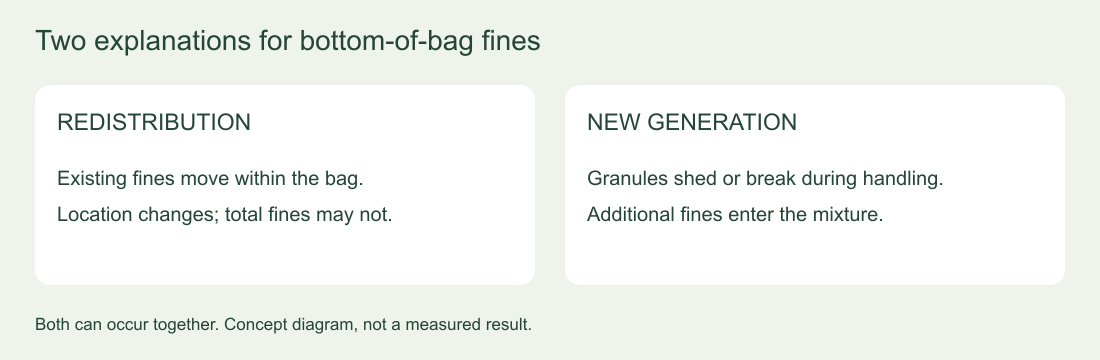
Does More Powder at the Bottom Mean New Fines or Redistribution?
Movement can separate particles within a mixture, concentrating fines in particular locations. New wear can add to that material. A bottom-of-bag sample consequently cannot be assumed to represent the whole bag or to prove that screening was missed.
Distinguishing redistribution from new generation calls for comparable samples and a defined handling history. This is a possible investigation approach, not a claim that transport simulation is a routine LINGSHUAI test.
6. Why Can Litter Release Little Dust Initially but More During Use?
Use can expose accumulated fines, create more through wear, and repeatedly disturb material already present. The first pour and the final scoop are different points in that history.
Can Digging and Repeated Scooping Generate New Fines?
Digging, stirring and scooping move particles against each other and against surfaces. Depending on their integrity, particles may shed material or break. Fine material can also accumulate as larger usable granules are removed or redistributed. More visible residue later does not, by itself, reveal how much was newly generated.
Why Do Pouring Height, Speed and Agitation Change Visible Dust?
Pouring changes particle impacts and the movement of surrounding air. A different height or flow can therefore change the visible plume even when the product is unchanged. A gentle demonstration and a rapid refill are not directly comparable observations.
These actions can both disturb existing powder and, where damage occurs, create new fines. Separating those mechanisms is essential when connecting customer feedback with production records.
7. How Do We Distinguish Dust Sources and Review a Dust Issue at LINGSHUAI?
We start by clarifying the reported phenomenon and the condition of the sample. One percentage or one video cannot establish whether the source was formulation, residual fines, moisture-related particle condition or later wear.
Why Do We Review Fines, Moisture and Granule Condition Together?
Our confirmed pre-shipment quality checks are performed for every batch and include observations of pouring dust and clumping behaviour. These observations provide context for the finished product; they should not be described as routine standardized airborne-concentration testing.
For source analysis, the relevant evidence includes the product and batch identity, the sampling location, moisture information where available, visible particle condition and the circumstances of pouring or handling. An arrival sample and a retained sample only support a meaningful comparison when their sampling and observation conditions are made comparable.
What Can Powder Content, Dust-Related Percentages and Pouring Observations Tell Us?
Powder content describes the result under its stated method. A dust-related percentage must likewise retain its original definition, sieve or handling conditions, and calculation. A pouring observation describes release under that particular action. None should be silently converted into another metric or into an absolute dust-free promise.
For us, tracing cat litter dust means connecting the material entering the process, the condition of the finished granules and the handling that follows. Screening removes a fraction already present; it cannot explain every later change. If you would like to discuss a particular formulation or sample, our team can review the confirmed product information and your requirements.